
Fifty years before the Rizzuto Family wrested control of Montreal from the Violi brothers, the Rizzuto family patriarch was murdered in an unlikely place.
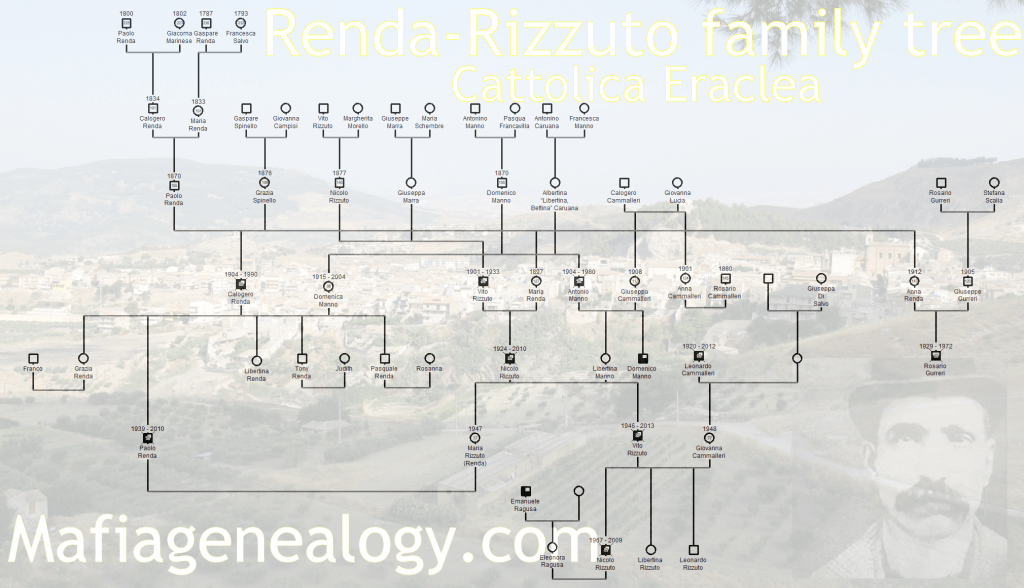
The story of the Sicilian-Canadian “Sixth Family” begins with the arrival of Vito Rizzuto and Calogero Renda in the United States in the mid-1920s. The brothers-in-law from Cattolica Eraclea, in Agrigento, Sicily, were destined for lives of crime in North America. It was in their blood.
For generations, the Rizzutos have made headlines in organized crime. Vito’s son, Nick Rizzuto (1924-2010), was at the Family’s head through the 1960-70s, when heroin poured through Montreal on its way into the United States. Nick’s son, named after his slain grandfather, took part in the assassinations of three Bonanno captains in New York City in 1981. Young Vito’s son, Nicolo’ (1967-2009), continued the family tradition.
Vito Rizzuto (1901-1933) and Calogero Renda (1904-1990) arrived in New Orleans together in January 1925, the year after the Immigration Act of 1924 severely limited visas for natives of southern Italy. Vito was newly wed to Maria Renda; Calogero was her unmarried younger brother. They resembled in many respects the scores of peasants with whom they traveled to New Orleans, who were destined for the sugar cane plantations of Louisiana. Rizzuto and Renda had no intention of doing farm labor. Their contact person in New Orleans, who they falsely claimed was a cousin, was more likely a criminal associate from the old country.
Rizzuto and Renda both soon made their way to the New York City area. Renda began the naturalization process at the end of 1927 and returned to Sicily two years later to marry a sister of the future Mafia boss of Cattolica. He returned to the US, and completed his petition for citizenship in 1931. Meanwhile, Rizzuto made a fateful career choice across the Hudson.
In October 1931, muckraker news publisher Max Simon hired John Chirichello to burn down his printing plant in Elizabeth, New Jersey, in order to collect on the insurance. Chirichello was a native of Sala Consilina, Salerno, in Campania, and emigrated as a young man. His regular line of work, going back to 1910, was his junk dealership, but in the 1930 census, the first year of the Great Depression, he said he was employed as a building contractor.
Chirichello told police that Simon had repeatedly pleaded with him to commit this arson job for him, as the insurance payout was his only hope of getting out of financial trouble. Possibly contracting, while more glamorous, had proven to be a less steady income, especially as it was a couple of years into the Great Depression.
Chirichello told police that he was initially resistant to Simon’s entreaties, as he’d been in some trouble recently. Not to mention, he was a married man with eight kids at home. Nonetheless, he brought Vito Rizzuto to see Simon’s building and discuss methods and materials. His statement to police includes Chirichello’s detailed description of how they prepared the building to burn.
Chirichello and Rizzuto did the job for an agreed upon price of $300, total, reached as a percentage of the estimated payout from insurance. A week after the fire, giving the insurance company time to cut Simon a check, Chirichello came back around to get paid. Simon complained that they hadn’t done the job well enough, and refused to pay. Rizzuto was incensed and threatened to kill Simon, so the publisher had one of his friends on the police force take Rizzuto’s gun. Disarmed and on his back foot, Vito Rizzuto decided to retreat.
Rizzuto went to Patterson, New York, near the western Connecticut border, and lived in a shack in a stone quarry. The only person who knew where he was was his friend Stefano Spinello (1898-1979) from Cattolica, who lived in the Bronx.
Given how easily the non-Italian Max Simon was able to find the man who could find Rizzuto, it seems they were all no more than a few degrees separated in the social network of the underworld.
Vito Rizzuto was murdered on 1 August 1933. Max Simon hired Spinello and another of Rizzuto’s friends from Cattolica, Rosario Arcuri (1895-1934), to find and kill him. They discovered Rizzuto sleeping in his lonely shack and beat him with heavy instruments, breaking his ribs and skull. Afterward, his killers dragged the body into a nearby swamp.
Simon went to prison for a three-year sentence for arson and served nine months. Spinello went to Sing Sing for murder and served a 7-20 year sentence. Chirichello, who turned on Simon and some of his fellow arsonists in another New Jersey case, served nine months for burning Max Simon’s building.
The other killer, Arcuri, was not captured; he was murdered in the Bronx the following summer. The crime remains unsolved. It appears likely that Rosario Arcuri’s cousin was somehow to blame for his discovery. John Guaragna, who lived on Morris Street in the Bronx, near Calogero Renda, told the INS in 1933 that his cousin had made a fraudulent petition for naturalization and was wanted in Italy for murder. Guaragna was the relative who released Arcuri’s body for burial: the closest family member he had in the city.
Vito Rizzuto’s wife and family didn’t join him in the US during his nine-year residence. His son, Nicolo, was born in Cattolica Eraclea in 1924. Nicolo Rizzuto married Libertina Manno, daughter of Cattolica’s Mafia boss. Nicolo, Libertina, and their two children emigrated in 1954 and settled in Montreal.
There was already an Italian organized crime presence in their new home: the Calabrian Cotroni-Violi gang from Sinopoli formed in Montreal in the 1950s and was led by Paolo Violi. Nicolo Rizzuto joined the gang’s Sicilian faction, under Luigi Greco. After Greco’s death, animosity between Nick Rizzuto and Paolo Violi grew to become an international issue. Rizzuto spent some years in the 1970s in Venezuela to avoid violence. His time there served his business interests, as he developed networking contacts for his narcotics trafficking operations.
After the assassinations of three of the Violi brothers, Rizzuto returned to lead the heroin operations in Montreal. Nick’s son, Vito (1946-2013), was groomed to take over his father’s position in the underworld, which he did after 2000. As a part of his training, in 1981 Vito Rizzuto was sent to New York City to participate in the assassinations of three captains in the Bonanno Family: Philip Giaccone, Dominick Trinchera, and Alphonse Indelicato. It would be years before justice caught up with him.
Calogero Renda, who made the trip with the elder Vito Rizzuto in the winter of 1924/25, emigrated to Montreal in 1958 with his family. He had proxy power over Nick Rizzuto’s Montreal operations during the years Rizzuto and his family lived in Venezuela. Calogero’s son Paolo (1939-2010), was an accountant and reputed consigliere for the Rizzuto Family. Paolo Renda was the younger Nick Rizzuto’s (1967-2009) godfather and uncle by marriage.
Paolo Renda committed the same kind of arson conspiracy as Max Simon in the 1930s, with the twenty-two year old grandson and namesake of the slain arsonist: Nick’s son Vito Rizzuto. Both men were seriously burned in setting Renda’s barber shop ablaze in 1968, and Vito was captured on the scene by police.
Vito Rizzuto (1946-2013) was finally convicted for the 1981 shootings in 2007. While he was away, his son, Nick, was assassinated at age 42. The following year, Paolo Renda disappeared, never to be seen again. And Vito’s father, Nick Rizzuto (1924-2010), who was 86, was shot to death outside his home.
Vito got out of prison and died from natural causes in 2013, when he was 67 years old. He has one surviving son, Leonardo, who is presumed to be the current leader of the Family.
In Cattolica Eraclea in 1955, the Mafia killed the mayor. Read about it on Patreon by becoming a subscriber at the Member ($3/month) level. Patreon Members of Mafia Genealogy support the research and writing you enjoyed here today, and get exclusive content created just for Mafia Genealogy’s biggest fans. Check out the Library of videos, stories, and images Members get instant access to. Researching and writing about Mafia families is my primary occupation. Whether it’s on Patreon or elsewhere, please support the history, educational content, and storytelling you want to see more of.
Sources
Atto di matrimonio, Calogero Renda and Domenica Manno. (1929, December 18). Record no. 60. “Italia, Agrigento, Agrigento, Stato Civile (Tribunale), 1866-1942,” images, FamilySearch (https://familysearch.org/ark:/61903/3:1:3QS7-L9D6-84H5?cc=1946817&wc=MT34-F9W%3A243916801%2C993065801 : 20 May 2014), Cattolica Eraclea > Matrimoni 1929 > image 167 of 176; Tribunale di Agrigento (Agrigento Court, Agrigento).
Complaint no. 2270-C-3219647. (1933, October 10). The National Archives in Washington, DC; Washington, DC, USA; Subject Index to Correspondence and Case Files of the Immigration and Naturalization Service, 1903-1952; NAI Number: 4490783; Record Group Title: Records of the Immigration and Naturalization Service; Record Group Number: 85; Series Number: T458; NARA Roll: 8 Roll Content Description: Citizenship – Constanzia Ancestry.com. U.S., Subject Index to Correspondence and Case Files of the Immigration and Naturalization Service, 1903-1959 [database on-line]. Lehi, UT, USA: Ancestry.com Operations, Inc., 2010.
Death of Calogero Renda. (1990, March 6). Drouin Genealogical Institute; Quebec, Canada; Quebec Death Indexes, 1926-1997 Quebec, Canada, Death Registers 1926-1997 [database on-line]. Lehi, UT, USA: Ancestry.com Operations, Inc., 2024.
Declaration of intention, Calogero Renda. (1927, December 21). Declaration no. 90903. “New York, U.S. District and Circuit Court Naturalization Records, 1824-1991,” database with images, FamilySearch (https://familysearch.org/ark:/61903/3:1:3QS7-99HF-4VGP?cc=2060123&wc=M5P2-K66%3A351696501 : 12 June 2020), Petitions for naturalization and petition evidence 1931 no 178492-178600 > image 373 of 420; citing NARA microfilm publication M1972, Southern District of New York Petitions for Naturalization, 1897-1944. Records of District Courts of the United States, 1685 – 2009, RG 21. National Archives at New York.
Domenica Renda [Obituary]. (2004, February 16). The Gazette (Montreal, Quebec, Canada). P. 40. https://www.newspapers.com/article/the-gazette-obituary-for-domenica-renda/113988447/
Humphreys, A. (2012, October 22). The Rizzutos’ Sicilian roots: Tracing the Quebec mob’s ties to Cattolica Eraclea. National Post. https://nationalpost.com/news/canada/the-rizzutos-sicilian-roots-tracing-the-quebec-mobs-ties-to-cattolica-eraclea
Hunt, T. (2010, July). Rivals move against Rizzutos of Montreal. Informer Journal. P. 53.
Lamothe, L. and Humphreys, A. (2006). The sixth family: the collapse of the New York Mafia and the rise of Vito Rizzuto. John Wiley & Sons Canada, Ltd. Print.
Manifest of the SS Edam. (1925, January 19). Lines 1-2. The National Archives At Washington, D.C.; Washington, D.C.; Passenger Lists of Vessels Arriving At New Orleans, Louisiana, 1903-1945; NAI Number: 4492741; Record Group Title: Records of the Immigration and Naturalization Service; Record Group Number: 85 Roll Number: 103 Ancestry.com. New Orleans, Louisiana, U.S., Passenger Lists, 1813-1963 [database on-line]. Lehi, UT, USA: Ancestry.com Operations, Inc., 2006.
Manifest of the SS Roma. (1930, April 6). Line 7. “New York, New York Passenger and Crew Lists, 1909, 1925-1958,” database with images, FamilySearch (https://familysearch.org/ark:/61903/3:1:33SQ-G54Z-GL5?cc=1923888&wc=MFV1-GNG%3A1029927901 : 2 October 2015), 4708 – vol 10236-10237, Apr 6, 1930 > image 169 of 947; citing NARA microfilm publication T715 (Washington, D.C.: National Archives and Records Administration, n.d.).
Petition for citizenship, Calogero Renda. (1931, February 25). Petition no. 178590. “New York, U.S. District and Circuit Court Naturalization Records, 1824-1991,” database with images, FamilySearch (https://familysearch.org/ark:/61903/3:1:3QSQ-G9HF-4VRV?cc=2060123&wc=M5P2-K66%3A351696501 : 12 June 2020), Petitions for naturalization and petition evidence 1931 no 178492-178600 > image 374 of 420; citing NARA microfilm publication M1972, Southern District of New York Petitions for Naturalization, 1897-1944. Records of District Courts of the United States, 1685 – 2009, RG 21. National Archives at New York.
Rizzuto crime family. [Wikipedia entry]. Accessed 11 February 2025. https://en.wikipedia.org/wiki/Rizzuto_crime_family
Rizzuto funeral on Saturday. (2009, December 31). CBC News [website]. https://www.cbc.ca/news/canada/montreal/rizzuto-funeral-on-saturday-1.808801
Rossat, F. (2023, August 28). La mafia de Montréal: Origines, relations et connexions avec les différents groupes mafieux d’Italie. Une histoire de crime organise [website]. https://unehistoiredecrimeorganise.blogspot.com/2023/08/la-mafia-de-montreal-origines-relations.html
 Mafia Genealogy
Great work !
LikeLike