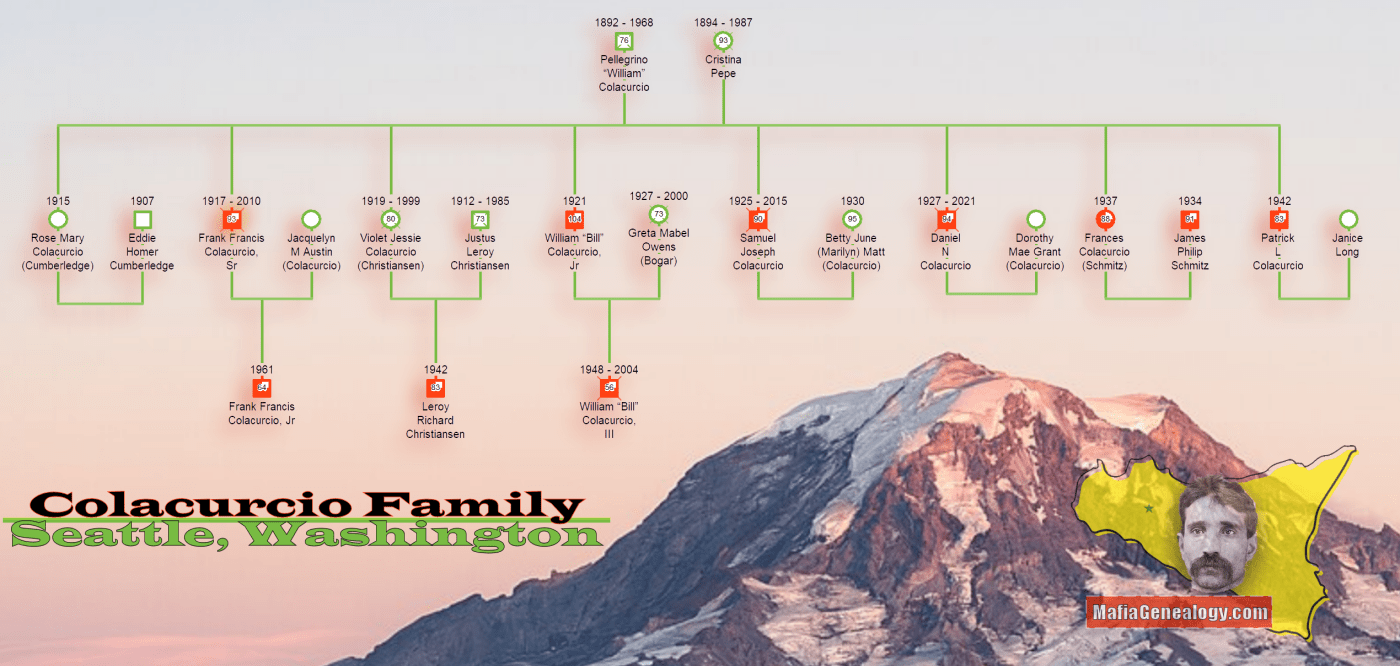
Frank Colacurcio and his brothers, farm boys from outside of Seattle, Washington, made up the core of a vice cartel featuring topless bars, gambling, and prostitution.
One of the first stories that appears in the newspapers concerning the Colacurcio brothers was during World War II. In 1942, Frank, Bill, and Sam Colacurcio rented a 28-acre working farm near Bellevue, Washington: about ten miles north of Seattle. The farm’s owner, Takeshi “Tack” Sakaguchi, was one of about 120,000 Japanese nationals who were forcibly relocated and incarcerated for the duration of the war.[1]
What made this transaction newsworthy was not the human rights abuse, which was described smoothly as “relocation,” but a ghost which Mr. Sakaguchi told his new tenants haunted the farm. The brothers caught sight of the specter on a number of occasions and gave chase, with no results. A girlfriend of one of the brothers had more success with her own methods, which were only hinted at in articles. Having seduced the ghost to close the distance between them to some fifty feet, she claimed to hear a voice with a message from the beyond, which seemed to be saying “Shame on you.”[2]
Frank’s early life
Eldest brother Frank Colacurcio, who was 25 in 1942, got an early start in life. Born in 1917, he was the oldest son and second-born of eight children. Their father, Pellegrino Colacurcio, was a pioneering truck farmer in the Duwamish swamplands of southern King County, Washington, where Frank was born and raised. He and his siblings learned first-hand how to grow vegetables and transport them for sale in Pike’s Peak Market in Seattle. After eighth grade, at the beginning of the Great Depression, Frank left school and became a full-time truck driver.[3]
The Colacurios were surrounded by other farming families, many of them Italian. Still, it’s likely that most of the Colacurcio family’s interactions with other Italians happened in “Garlic Gulch,” in the northern part of the Rainier Valley. So-called because of its mix of mainland Italian and German immigrants, Garlic Gulch was the beating heart of Seattle’s Italian community. Every Italian family in Seattle knew nearly every other, because they came together here. The Colacurcio children would have attended the Italian school in Garlic Gulch, and listened to Father Caramello’s sermons in Our Lady of Mount Virgin Catholic Church on Sundays.[4]
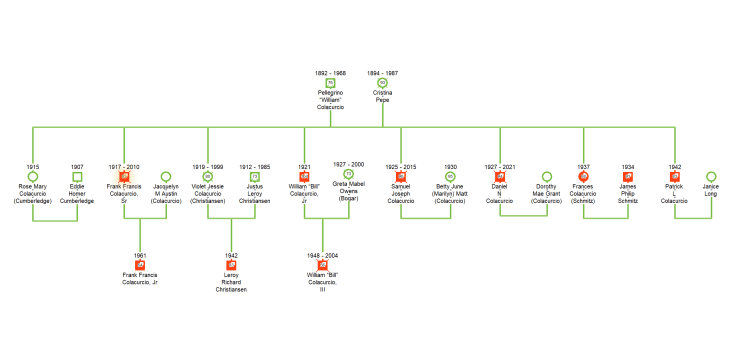
Pellegrino and Christina (Pepe) Colacurcio had eight children. All of them married. All of their sons, one of their daughters, a son-in-law, and three of their grandsons took part in the Colacurcio enterprise.
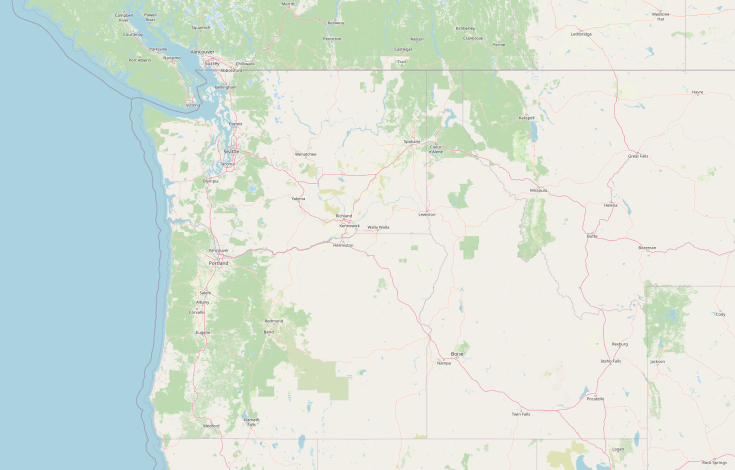
The northwest continental United States including Portland, Seattle, and Coeur d’Alene.
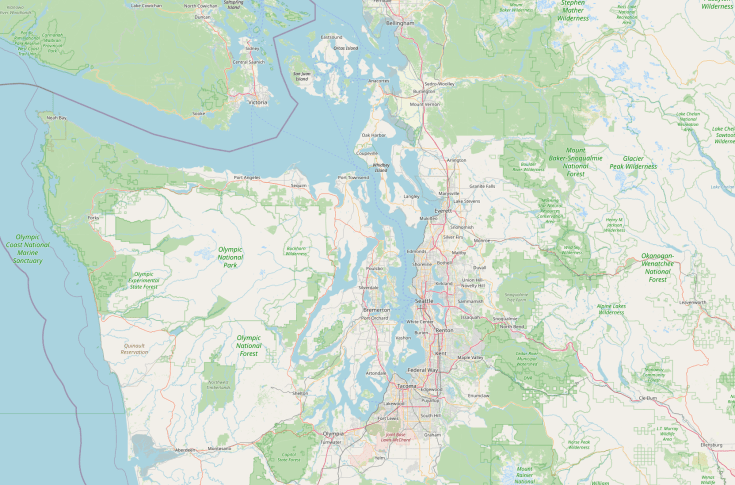
Zooming in on the Puget Sound region.
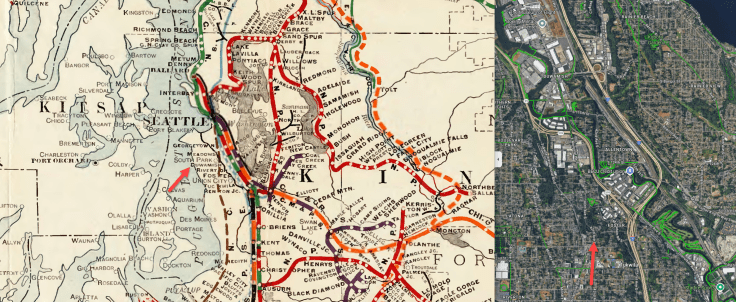
A 1910 railroad map of the region, and the approximate location of the Colacurcio farm.
Frank’s family of origin
Pellegrino Colacurcio was born in Serino, in Avellino province, in the Campania region of Italy.[5] He immigrated in 1910, joining a brother-in-law in Philadelphia.[6] In 1917, he registered for the draft in June, and filed first papers toward naturalization in December. Between June and December, he went from living in Seattle and supporting his wife and child with employment as a gardener, to owning a farming household in unincorporated King County.[7]
The second-oldest brother was fourth-born William Jr., born in 1921 and named for their father, who was called William or Bill.[8] After Bill Jr., the next child born was Samuel Joseph, in 1925, making the three oldest Colacurcio brothers 25, 21, and 17 the summer they rented a farm together.[9]
By 1940, two of the Colacurcio sisters were married. Frank lived with the younger sister, Jessie, and her husband Justus Christiansen. Seventy years after Uncle Frank lived with him, Jessie’s son, Leroy Richard Christiansen, pleaded guilty to prostitution and racketeering for the Colacurcio organization.[10] Frank worked as a produce salesman for M. Yamada near Pier 54.[11] Pikes Place Market, the famed market where farmers like the Colacurcios sold their produce, was about six blocks north near Pier 62. Possibly Frank’s 1940 employer connected him somehow to Sakaguchi, the farm owner the Colacurcio brothers rented from in 1942.
WWII-era assault on the ghost ranch
As far as I can tell, William Colacurcio, Sr. never completed his petition for naturalization, although he declared his intention to become a US citizen in 1917. With the second World War came new restrictions on alien enemies, particularly those who lived near the ocean. The social life that once buzzed in Garlic Gulch in the evenings died down as Italian nationals found themselves under an 8 PM curfew. The Italian language classroom closed. A popular radio host, Nick Paolella, was detained by federal agents.[12]
The summer the brothers rented the Sakaguchi farm, Frank drove a sixteen year old girl to his “ghost ranch” and assaulted her. She immediately filed rape charges, and he was convicted of the reduced charge of “carnal knowledge.”[13] Later on, rumors expanded the story, including a detail that would follow one man for the rest of his career. Al Rosellini, the future Washington state governor and lawyer, began his long political journey in Garlic Gulch, and was rumored to have been Colacurcio’s lawyer in this case.[14] Someone behind the scenes was pulling for Frank, because he was sentenced to twenty years at the state reformatory, and paroled just one year later.[15]
Frank’s rise in the underworld
Frank got in trouble again in 1949 for dispensing hard liquor without a license.[16] Then he didn’t appear in the news again until 1956, when he was called a “prominent Seattle fringe operator” whose “plush beach home” was visited late one night by police hoping to serve Portland racketeer Thomas Maloney an arrest warrant. Colacurcio’s name had already made its way to Portland, Oregon, thanks to secret recordings made by local crime boss James B. “Big Jim” Elkins.[17]
What happened in between 1949 and 1956 was the beginning of Frank’s career as a salesman for his brother’s pinball business. In 1954, leadership of the Teamsters union took over the pinball machine business in Portland, having done the same in Seattle many years earlier. Unaffiliated pinball operators could expect to find their clients’ taverns and restaurants picketed, and business owners clamoring to get rid of the offending equipment. The single exception in Seattle was Frank’s brother Bill Colacurcio, Jr., the biggest pinball machine dealer in the city.[18]
Elkins’ involvement with Frank Colacurcio was minimal—they once discussed Colacurcio doing business in Portland, but they never worked together.[19] An area of overlap worth mentioning is their relationships to the Teamsters and the pinball machine business, which became the subject of scrutiny: first by local law enforcement in Seattle, and then by the US Senate Rackets Investigating Committee.[20]
In 1956 in Portland, Big Jim Elkins was called an underworld vice “czar” of many years, protected by his relationships with public officials. The description appeared in an article about how AFL-CIO political strategist George Brown convinced International Teamsters representative Clyde Crosby not to say these things about Elkins in a speech to the Portland Central Labor Council, for fear it would cause a serious disturbance.[21]
Teamsters
The gangster chieftains of Portland and Seattle wielded significant power in the union and were at odds with members of the Teamster leadership. Elkins used the organization’s press credentials to get horse racing results for his betting operations. And while Crosby was evidently hostile to Elkins, Colacurcio thought he could get the representative to intervene on his behalf in pursuit of a few brothels he discussed with Elkins, by getting the mayor to fire the police chief if he didn’t agree to protect Colacurcio’s assets in Portland. The mayor was running for reelection, and would lose without the Teamsters’ support—andFrank told them how to vote.[22]
Frank and Bill Colacurcio were outed by Elkins’ testimony and the secret recordings he made of underworld deals. Bill ran into other trouble, too, as the city of Seattle refused to renew his pinball license in 1958. Some of the businesses they catered to—not only bars, taverns, and nightclubs, but family-friendly places like restaurants, bowling alleys, and soda fountains—attracted teenagers, which alarmed parents and elders who saw pinball machines as a juvenile gateway to crime. It didn’t help that pinball distribution had a deserved reputation for being “mobbed up.” Being shut out of the pinball industry in Seattle, the brothers pivoted to jukeboxes, forming the Colacurcio Amusement Company with newlywed younger brother Sam.
Politicians
The method that the Colacurcios perfected through the 1940s and ‘50s, and exported to other states for decades longer, involved making generous campaign contributions to politicians who agreed to give them favors. Albert Rosellini was the son of Italian immigrants. His father Giovanni Rosellini was from Lucca, in Tuscany.[23] Giovanni had a saloon in Tacoma with his brother Vittorio before Prohibition.[24] He went on to own a restaurant, and then become a real estate professional.[25]
Giovanni Rosellini’s son was also ambitious: a Washington state senator for eighteen years, and then governor for eight more, Albert Rosellini was alleged to have a connection of many years with Frank Colacurcio: a relationship he would deny in the 1970s.[26] In January 1958, Frank was charged with four counts of threatening bodily harm. His sales pitch for the new Amusement Company to tavern owners was this: either accept his jukebox in their establishment, or he’d “stomp” them and use his relationship with Governor Albert D. Rosellini to go after their liquor licenses.[27]
A year later, in February 1959, Frank told the Senate committee investigating the ownership and distribution of jukeboxes and pinball machines that he had sold his interest in coin machine businesses. The industry connection still followed him into his next big venture, topless dancing.
Vice
In 1962, the World’s Fair was held in Seattle. Frank ran a wine and beer garden called the Diamond Horseshoe which featured dancing girls. Four of the girls were discovered to be underage, resulting in a $500 fine for Frank.[28] A gambler who worked for the Diamond Horseshoe as a bartender, Arthur Baldwin, later testified that it was Frank’s practice to have cash skimmed off his nightclubs and brought directly to him at his home or office.[29]
Under Colacurcio’s mentorship, Baldwin climbed the ranks of his nightclub empire and learned how to run both sides: the legal nightclubs and taverns, and the illegal prostitution and gambling which went on behind the scenes. One of the lessons Baldwin took away was the use of relatives with clean criminal records to be the officers and managers of his businesses. When he moved to Tennessee, he installed his ex-wife in Nashville with nightclubs to manage.[30]
He learned from Colacurcio how to make himself an indispensable friend to politicians and police. However, he played a dangerous game by working both sides, when he became an informant in a federal investigation into bribery in Tennessee Governor Ray Blanton’s administration. He had convictions in Washington state for cocaine possession as well as tax evasion and bribery.[31] The owner of a string of Playgirl clubs in the Memphis area, Baldwin was a convicted felon barred from the industry. Added to that was a new $226,000 lien from the IRS: all of these factors may have encouraged him to cooperate.[32]
B-I-N-G-O
Frank Colacurcio married Jacquelyn Austin in Coeur d’Alene, Idaho, in January 1962.[33] They had one child, Frank Jr., born the previous October.[34] Frank and Jacquelyn divorced in 1994.[35]
Back in Seattle, Frank Sr. got into the bingo business. By 1965 he had a chain of bingo games, each of them kicking up a thousand dollars a month to operate. Bingo games were illegal but Colacurcio paid off police to maintain a so-called “tolerance policy.”[36]
Before this story broke, in 1968 it came out that Frank had a secret financial interest in the Mirror Room in the Olympus Hotel. Convicted felons were not allowed to own or manage a venue that served alcohol. It was discovered that Frank’s brother-in-law, James Schmitz, managed the club despite having been turned down by the liquor board.[37]
Incursion into Pierce County
In 1972, while Baldwin was still in Seattle and at the height of his partnership with the Colacurcios, Frank and William Colacurcio opened the Tiki nightclub in Tacoma, WA, and made Baldwin its manager.[38] (An alternate telling of this story has Frank and Arthur open the club together in their own names.) This was the Colacurcio organization’s first foray into Pierce County, Washington: a bold move, since Tacoma and surrounding Pierce County were the territory of John Joseph Carbone.[39]
Carbone was the son of immigrants from Aprigliano, in Calabria, Italy. He was a gambler, used car dealer, former teamster, and the counterpart to Colacurcio in that he led the topless tavern industry in Pierce County, where his businesses catered to military clientele from Fort Lewis.[40] His nightclubs and taverns, like Colacurcio’s, were fronts for gambling and prostitution.[41] The so-called “Carbone-Williams enterprise,” referring to John Carbone and his business partner Ron Williams, were accused in a federal indictment of causing a string of arsons in their own and competing businesses in order to collect on insurance claims and force their competitors out of Pierce County.[42]
While the Colacurcio organization was making this incursion, Frank Colacurcio, Sr. was in federal prison, having been sentenced to three years for interstate transportation of bingo equipment.[43] When he was paroled in 1976, the arson war between the Colacurcio organization and the Carbone-Williams enterprise was just about to heat up.[44] It came out during the lead up to the trial that fire investigation staff was cut by nearly half during the arson war.[45] The Pierce County sheriff, John and Joseph Carbone, Ronald Williams, and four others were arrested for RICO violations.[46]
The Carbone-Williams enterprise was found guilty of the charges of causing fires at competing taverns in order to control a monopoly on Pierce County nightlife. John Joseph Carbone was sentenced to 25 years.[47] Frank Colacurcio was drawn in as an alleged victim, but he denied even that much, claiming not to be in the tavern business in Pierce County.[48] Williams was convicted of racketeering and conspiracy to arrange for the murder of Frank Colacurcio.[49]
What makes a family mafia?
Were Carbone and Colacurcio mafia bosses or did they not rise to the level of organization necessary to categorize them alongside the Bonannos and Marcellos? Law enforcement, quoted in a 1980 article on organized crime in Washington state, described the marketplace in the Pacific Northwest as unprofitable, and therefore a late destination for both legal and illegal franchises.[50]
Yet, through much of the 1970s, the organized crime intelligence unit of the Washington State Patrol claimed that three local crime families operated in Washington state. The Shoshone News-Press, reporting on this in 1980, went on to describe the many enterprises and corruption plots in which Colacurcio and Carbone were allegedly involved.[51] A 1985 report by the New Mexico Governor’s Organized Crime Prevention Commission called the Colacurcio organization a “non-Mafia organized criminal group” and a “criminal cartel.”[52]
What distinguishes a Mafia group from a cartel? By studying Frank Colacurcio, Sr. and his empire of sex, perhaps we might learn the difference between a mafioso and the leader of a family-based vice cartel who happens to be Italian American.
Mutual recognition
Some will point to the Commission and relationships among its member Families as the only recognized Mafia presence in the United States, but I would counter that this is not how mafia researchers define mafia. It would be like saying the NFL is the only organization that can recognize a professional football team. Inter-cosca relations have never been a dominant force in any of the Italian mafias. They were ad hoc for most of the Sicilian Mafia’s history, and have never had the power to define the cosca. Crime bosses are not elected or appointed, except to ratify what is already apparent. It is the mafioso himself, his actions, and the people who live in his territories who decide who is a mafioso and who is simply a criminal.
Methods
A cartel is a coalition of interests who conspire to create a monopoly, limit competition, or fix prices in their industry. These are all illegal business practices—conspiracies—making cartels synonymous with crime. The interests making up a cartel’s membership depend on the product. They can be legitimate businesses, unions, or industry associations, criminal gangs, and individuals.
Membership
However, in order to call a cartel or gang a mafia, there must be certain limits placed on membership: mafias are ethnic gangs. Mafia families are more durable than non-mafia gangs: strong enough to resist the state and collaborate with officials in ways that mere “bandits” do not.[53] While the cosca is centered on the mafioso and his immediate family, membership in the mafia makes one part of something larger, which outlives the mafioso.
This is why membership is limited by ethnicity: the distinctive culture that holds a cosca together is the same glue that holds together members’ families, congregations, neighborhoods, and towns. German criminologist and sociologist Henner Hess, who has conducted fieldwork in the Palermo countryside and written extensively about the subject, calls the mafia “a set of methods bound by culture.”[54]
Territory
In his Mafia & Mafiosi, Hess describes a typical territory containing not just one, but many mafiosi at different levels of strength and phases of life.[55] Mafiosi can be like cartels because both strive to create a monopoly through illegal means. They both have distinct physical or industrial territories whose boundaries help keep the peace. And when those lines are deliberately overstepped, it triggers violent conflict.
In a lean criminal landscape like the Pacific Northwest, where only a small percentage of Italian immigrants eventually settled, we can expect to find fewer mafiosi than in a city like New York. There’s less action for gangsters to divide, and fewer men from mafia backgrounds reaching for a piece of the pie.
The Italian community around Seattle and Tacoma was diverse and included many families who did not come from regions where mafias were indigenous. Pellegrino Colacurcio and the Colacurcio brothers’ principal rival, John Joseph Carbone, did come from such regions of Italy: their families would have known very well the Camorra in Avellino, and the ‘Ndrangheta in Calabria.
Anton Blok, a Dutch anthropologist who did field work in Palermo’s Contessa Entellina in the 1960s, defines the mafia through their use of violence to exert control.[56] John Carbone used arson to drive out his competitors. Frank Colacurcio made his name and fortune in Seattle nightlife on his reputation in the pinball machine and jukebox businesses, where he was found guilty of using credible threats of violence to “persuade” venue owners to install his machines. He went on to make his fortune in the same kinds of bars and clubs his old customers owned.
Whether his sales pitches varied much from before, matters less than that Frank Colacurcio personally demonstrated the ability to use violence to accomplish his aims. His reputation preceded him.
The French Quarter
Bill Colacurcio, Jr. was the first of the brothers to export the organization’s methods to another state. His first target was New Orleans, where the French Quarter supported hundreds of sex workers, gamblers, and drug dealers in the 1970s.
Bill married and divorced in Seattle in the 1940s and had one child, a son. He moved to Louisiana in 1967 and his son Bill Colacurcio III, who grew up with his mother, joined him after high school.[57] Together with the operators of another New Orleans nightclub, father and son challenged state regulations banning live sex shows in 1973.[58]
In 1979, a nine-month vice investigation culminated in a massive raid on the French Quarter. Bill Jr. was one of nine who faced federal racketeering charges for prostitution and gambling.[59] Along with his nude clubs on Bourbon Street, William financed a gambling room called “the Greek Italian Association Club” on Decatur Street that took in as much as $20,000 per night.[60] He was sentenced to thirty months in prison and fined $60,000.[61]
Bill Colacurcio III returned to his mother’s native Coeur d’Alene, Idaho, in the Nineties and opened a Thai restaurant. He died in 2004.[62] His son, Bill Colacurcio IV, was arrested for a string of driving and alcohol-related offenses in the Aughties.[63]
Alleged Mafia ties
William Colacurcio, Jr. was allegedly associated with Carlos Marcello’s Mafia Family in New Orleans. His brother Frank, likewise, was said to be associated with the Bonanno and Gambino Families through his controlling interest in two national cinema chains featuring hardcore pornographic films.[64] Frank was reportedly visited in prison by Bill Bonanno, and once met the father, Salvatore, but according to Colacurcio, nothing came of the meeting.
There is no hard evidence of working relationships between any of the Colacurcios and anyone in the American Mafia. The Colacurcio enterprises operated independently of any other organized crime interest, and relied heavily on corruption for their entry into new territories. There’s no proof of a relationship with Marcello, Bonanno, Galante, or Gambino, and no evidence of them kicking up to the boss in any of the territories in which they operated.
What there is ample evidence of is payoffs to politicians and police. A report by the Alaska governor’s Organized Crime Prevention Commission said it took states an average of twelve years to rid themselves of Colacurcio group members once they became established.[65]
Arthur Baldwin
Former bartender Arthur Baldwin, after climbing as high in the Colacurcio organization as he could without becoming kin, took the Colacurcio method and a few dozen strippers to Memphis, Tennessee in 1974.[66] A year after his arrival, Baldwin was convicted for tax evasion, due to his work for the Colacurcio brothers back in Washington.[67]
Before his incarceration, Baldwin established a string of successful Playgirl clubs which he continued to run through lieutenants, protected by his payoffs through Tennessee Governor Blanton’s “Memphis man,” J.P. “Speedy” Murrell. Unfortunately, one of Baldwin’s trusted inside men was an undercover police informant called Joe Hoing.
Baldwin got into a disagreement with another of his inner circle, David McNamee, with whom he owned a liquor store in Memphis. McNamee was found killed in July 1978. Around the same time, Baldwin was publicly identified as an informant in the investigation into corruption in the Blanton administration—the same governor Baldwin was paying off to protect his nightclubs. There was another investigation made into Baldwin’s businesses.[68] His other charges were dropped in consideration of his testimony.
Back in Washington, Frank Colacurcio and a business partner, Kent Chisman, were indicted by a federal grand jury in 1980 on charges of conspiring to file false tax returns. They were also charged with hiding Colacurcio’s financial interest in a Bellevue tavern.[69]
The youngest brothers and a second generation
In 1970, Frank’s youngest brother Patrick and their nephew, Leroy Christiansen, began opening topless nightclubs in Hawaii.[70] Patrick went on to open more locations in New Mexico in the 1980s, and was investigated for ties to venues in Arizona along with his brother, Samuel, who had previously operated nightclubs in Washington and New Mexico. Brother Daniel, born between Samuel and Patrick, ran clubs in Canada in the 1970s and helped start clubs in Arizona.[71]
Other associates
Not only family, but a handful of close working associates like Arthur Baldwin were accused of representing Colacurcio’s interests in other states. A Baldwin protege from his days at the Tacoma Tiki club, Steve Fueston, started out as a bartender and moved up to operating four clubs in El Paso, Texas, for the Colacurcios, with the support of a motorcycle gang who supplied both security and entertainment.[72] Fueston was indicted on four counts of cocaine possession with intent to distribute, and conspiracy for the same, in 1979 but the case ended in a mistrial; he went on to run another topless club in Colorado Springs that was closed in the mid-80s after it was discovered Fueston lied about Frank Colacurcio’s involvement.[73]
Colacurcio associates Ronald W. Chase and Paul B. Freimark applied to operate a topless bar in Portland, OR, but the liquor commission determined that their relationship to the Seattle family disqualified them: Freimark’s son worked for the brothers in Seattle and Hawaii.[74] And Gilbert K. “Junior” Pauole, who managed a tavern in Bellevue, WA for the Colacurcios, went on to manage a string of nude dancing nightclubs around Anchorage, Alaska that were shut down in 1979.[75]
Talents West
Linking many of these nightclubs were a talent and booking agency called Talents West and a consulting company for which two of the Colacurcio brothers worked. Talents West was originally owned by Frank Colacurcio, Sr. though he later called himself a member of the Talents West cooperative.[76] Regardless of his official role in the agency, Frank maintained an office in the company’s modest building in Seattle. The agency provided topless and nude dancers for nightclubs and other venues. Frank Colacurcio’s brother-in-law, James Schmitz, was the incorporator; his son, Frank F. Colacurcio, Jr., was the company’s president.[77] All of the clubs in the Colacurcio organization used Talents West for staffing, with the possible exception of El Paso, which also employed the wives and girlfriends of their motorcycle gang partners.[78]
Larry Martin Thomas, a business associate who was closely entwined in the Colacurcio organization, was the director of Thomas Management and Consulting, which advised faltering bars and taverns to convert to topless dancing venues. He owned and later consulted for topless clubs in El Paso, and scouted locations in Albuquerque, New Mexico with his management consultants, brothers Patrick and Samuel Colacurcio.[79]
Second prison term
In 1981, Frank Colacurcio was convicted for skimming the profits from two of his Seattle taverns. It would be his second conviction for income tax evasion; the first, in 1974, was overturned. The second time he was not so lucky.[80] He went to prison in August 1982 and was released in March 1985.[81] This was the second and last time he went to prison; the first sentence was for bingo equipment he brought in from out of state, which he served from 1974-76.
Frank suffered a suspected heart attack in August. A topless club in Portland called Jiggles, which opened while he was in prison, was later suspected of being secretly controlled by him. The club was owned and managed, unofficially, by Frank’s brother-in-law, James Schmitz, who had worked in Frank’s clubs since the Sixties, and had been financed with a loan from Larry Martin Thomas, the management consultant. Investigations found that Jiggles was in regular contact with other Colacurcio-affiliated nightclubs in other states.[82]
Strippergate
In the Nineties, Frank Colacurcio, Sr. divorced and moved to Snohomish County.[83] He returned to Seattle before his death. His son, Frank Jr., married and divorced without having children.[84] Frank Jr. married again and had three children with his second wife. They divorced in 2004.[85]
Three city council members in Seattle’s Sixth District were accused of accepting campaign contributions from the Colacurcio family in 2003’s “Strippergate scandal” in exchange for their votes in favor of a zoning variance for one of the empire’s strip clubs.[86] When Al Rosellini became involved in the decision to rezone a parking lot, his relationship with Frank Colacurcio was once again examined in the press.[87]
Last racketeering prosecution
In 2008, a sting on Fox’s found that dancers were incentivized to engage in prostitution by management: Frank Francis Colacurcio, Jr., his cousin Leroy Richard Christiansen, Frank Sr’s driver John Gilbert Conte, David Carl Ebert, and Steven Michael Fueston, the management consultant.[88] The investigation expanded to include Frank Sr. Talents West and Frank’s most profitable nude club, Honey’s, were shut down. Frank Jr. pleaded guilty to federal conspiracy.[89] A week later, 93-year old Frank Colacurcio Sr. died while being prosecuted for racketeering.[90]
Bikini baristas
In 2013, a sheriff’s sergeant in Everett, Snohomish County, Washington, was arrested for protecting a line of “bikini baristas” in exchange for sexual favors. The Java Juggs chain was connected to the Colacurcio empire through the owner, Carmela Panico (1962-). Panico and her posse of perky “pick me up” purveyors were a daytime extension of the Colacurcio nightlife empire: an “adult-oriented entertainment” that served as a front for prostitution.[91]
Panico pleaded guilty to prostitution and money laundering in September 2013, but for more than a year after, continued to earn rent on her coffee stands from her manager, Samantha Lancaster (1991-).[92] Both Panico and Lancaster admitted to engaging in sex acts with Snohomish County sheriff’s sergeant Darrell O’Neill (1955-), a 30-year veteran, in exchange for warnings of police stings.[93] O’Neill resigned and went to jail for a year for sharing information on undercover police investigations with Panico. Panico and Lancaster both testified against O’Neill; neither went to jail.
Panico, who spent her career in the adult entertainment industry, had long worked as an exotic dancer for Talents West, including in at least four nightclubs owned by Frank Sr.[94] It was Panico’s connection to the Colacurcios that prompted the FBI to aid Everett police in their investigation.[95] Several baristas told investigators they were afraid to cross the owner because of her connections to the Colacurcio family.[96]
Sources
[1] “United States, War Relocation Authority centers, final accountability rosters, 1942-1947”, FamilySearch (https://www.familysearch.org/ark:/61903/1:1:QLXR-F43K : Sat Apr 26 01:56:31 UTC 2025), Entry for Takeshi Tak Sakaguchi, 19 Jul 1942; Ghost on Washington farm eludes would-be captors. (1942, August 18). Great Falls Tribune (MT). P. 1; Valkenburg, C. B. (1995). An Alien Place: The Fort Missoula, Montana, Detention Camp, 1941-1944. Pictorial Histories Pub.
[2] ‘Shame on you’ says ghost to Wiley woman. (1942, August 20). St. Albans Daily Messenger. P. 11.
[3] Colacurcio—a profile. (1980, July 2). The Columbian (Vancouver, WA). P. 26.
[4] Coughlin, J. (2013, August 30). Seattle’s Italian community. Jovina Cooks [website].
https://jovinacooksitalian.wordpress.com/2013/08/30/seattles-italian-community; Cipalla, R. Garlic Gulch (Seattle). (2022, February 1). HistoryLink.org [website]. https://www.historylink.org/File/21393
[5] Atto di nascita, Pellegrino Colacurcio. Record no. 152. Archivio di Stato di Avellino > Stato civile italiano > Serino > 1892 > Nati https://antenati.cultura.gov.it/ark:/12657/an_ua654446/LqpVDkq Img 63 of 117.
[6] “New York City, New York, United States records,” images, FamilySearch (https://www.familysearch.org/ark:/61903/3:1:3Q9M-C9TQ-FSMF-G?view=explore : Aug 1, 2025), image 781 of 1007; United States. National Archives and Records Administration. Image Group Number: 007673480
[7] “King, Washington, United States records,” images, FamilySearch (https://www.familysearch.org/ark:/61903/3:1:33S7-L1WF-BW?view=explore : Aug 1, 2025), image 1040 of 5641; United States. National Archives and Records Administration,United States. National Archives and Records Administration. Atlanta Branch. Image Group Number: 005243514; “King, Washington, United States records,” images, FamilySearch (https://www.familysearch.org/ark:/61903/3:1:33S7-95XZ-9HLM?view=explore : Aug 1, 2025), image 71 of 483; Washington State Archives. Image Group Number: 004343737
[8] “Washington, County Birth Registers, 1873-1965”, FamilySearch (https://www.familysearch.org/ark:/61903/1:1:D6DH-1BW2 : Fri Mar 08 23:39:20 UTC 2024), Entry for Daniel Aniello Colacurricio and Wm Colacurricio, 22 Aug 1927.
[9] “Washington, United States records,” images, FamilySearch (https://www.familysearch.org/ark:/61903/3:1:3Q9M-CSYY-RSCJ-G?view=explore : Aug 7, 2025), image 334 of 2448; National Personnel Records Center (St. Louis, Missouri). Image Group Number: 104952308
[10] Strip club owner, racketeering defendant dies. (2010, July 3). The Daily Herald (Everett, WA). P. 8.
[11] “Washington, United States records,” images, FamilySearch (https://www.familysearch.org/ark:/61903/3:1:3Q9M-CSYY-R958-Z?view=explore : Aug 6, 2025), image 333 of 2448; National Personnel Records Center (St. Louis, Missouri). Image Group Number: 104952308
[12] Coughlin, J. (2013, August 30). Seattle’s Italian community. Jovina Cooks [website]. https://jovinacooksitalian.wordpress.com/2013/08/30/seattles-italian-community
[13] Attack charges filed against Bellevue man. (1942, August 21). The Seattle Star. P. 3; Terms set by parole board. (1943, October 12). The Seattle Star. P. 7.
[14] O’Brien, P. (1985, August 25). Colacurcio ‘family’ ousted. Anchorage Times. P. 4; Scarpo, E. (2014, June 13). Seattle’s crime boss: Mafia malarkey—or was it? Cosa Nostra News. https://www.cosanostranews.com/2014/06/seattles-crime-boss-mafia-malarkey-or.html#google_vignette
[15] Colacurcio—a profile. (1980, July 2). The Columbian (Vancouver, WA). P. 26.
[16] Woman draws fine. (1949, August 26). The News Tribune (Tacoma, WA). P. 34.
[17] Turner, W. and Lambert, W. (1956, July 12). Raid in Seattle fails to snare Maloney. The Oregonian (Portland, OR). P. 1.
[18] Turner, W. and Lambert, W. (1956, April 22). Crosby pilots rebuff of Commissioner Earl as reprisal for ‘no.’ The Sunday Oregonian (Portland, OR). Pp. 1, 35.
[19] McClellan praises patriotism of witnesses who defy threats. (1957, February 28). The Oregonian (Portland, OR). Pp. 8, 9.
[20] Seattle man gets subpoena. (1959, February 1). The Bellingham Herald (WA). P. 5.
[21] Weber, S. (1956, April 24). Peace plea halts blast by Crosby. The Oregon Daily Journal (Portland). P. 1.
[22] McClellan praises patriotism of witnesses who defy threats. (1957, February 28). The Oregonian (Portland, OR). Pp. 8, 9.
[23] “Washington, Death Certificates, 1907-1960,” database, FamilySearch (https://familysearch.org/ark:/61903/1:1:N31P-2Z6 : 10 March 2018), John Rosellini, 12 Nov 1959; citing Seattle, King, Washington, reference 22447, Bureau of Vital Statistics, Olympia; FHL microfilm 2,034,000.
[24] “United States City and Business Directories, ca. 1749 – ca. 1990”, FamilySearch (https://www.familysearch.org/ark:/61903/1:1:68J4-1MC8 : Thu Mar 07 17:18:11 UTC 2024), Entry for John Rosellini, 1909; “Washington, United States records,” images, FamilySearch (https://www.familysearch.org/ark:/61903/3:1:33SQ-GYYX-LMR?view=explore : Aug 4, 2025), image 367 of 1378; United States. National Archives and Records Administration. Image Group Number: 005157550.
[25] “Washington, United States records,” images, FamilySearch (https://www.familysearch.org/ark:/61903/3:1:33S7-9RN6-8DV?view=explore : Aug 4, 2025), image 1028 of 1221; United States. National Archives and Records Administration. Image Group Number: 004968998; “Washington, United States records,” images, FamilySearch (https://www.familysearch.org/ark:/61903/3:1:33S7-9RN6-8DV?view=explore : Aug 4, 2025), image 1028 of 1221; United States. National Archives and Records Administration. Image Group Number: 004968998
[26] Barouh, C. (1972, November 8). Rosellini attempts to assess reasons he failed in his bid. The Columbian (Vancouver, WA). P. 5.
[27] Music machine dealer charged. (1958, January 11). The Everett Daily Herald (WA). P. 1.
[28] Dancing girls brings big fine. (1963, September 15). The Bellingham Herald (WA). P. 3.
[29] Steverson, W. and Chisum, J. (1980, January 20). Street gambler to club owner. The Commercial Appeal (Memphis, TN). P. 77.
[30] Sherborne, R. (1979, December 23). Man of varied masks works 2 sides of law. The Tennessean (Nashville, TN). Pp. 1, 14.
[31] Shomshak, V. (1975, December 4). The News Tribune (Tacoma, WA). P. D-12; Sherborne, R. (1979, December 23). Man of varied masks works 2 sides of law. The Tennessean (Nashville, TN). Pp. 1, 14.
[32] Steverson, W. and Chisum, J. (1980, January 20). Street gambler to club owner. The Commercial Appeal (Memphis, TN). P. 77.
[33] Licenses to wed. (1962, January 26). Spokane Chronicle. P. 5.
[34] “United States, Residence Database, 1970-2024”, database, FamilySearch (https://www.familysearch.org/ark:/61903/1:1:6TGY-JPBP : 4 June 2024), 1991.
[35] “Washington, Divorce Index, 1969-2014”, FamilySearch (https://www.familysearch.org/ark:/61903/1:1:QLC4-QL7Z : Sat Feb 22 00:26:03 UTC 2025), Entry for Frank F Colacurcio and Jacqueli M Austin, 14 Feb 1994.
[36] Grand jury indicts three in bingo case. (1970, February 27). Spokane Daily Chronicle. P. 24; Modie, N. (1970, February 27). Indicted Tacoman maintains he’s not guilty. The News Tribune (Tacoma, WA). P. 1.
[37] State probes Mirror Room management. (1968, June 24). The Tacoma News Tribune. P. 33.
[38] Sherborne, R. (1979, December 23). Man of varied masks works 2 sides of law. The Tennessean (Nashville, TN). Pp. 1, 14.
[39] Steverson, W. and Chisum, J. (1980, January 20). Street gambler to club owner. The Commercial Appeal (Memphis, TN). P. 77.
[40] “Pierce, Washington, United States records,” images, FamilySearch (https://www.familysearch.org/ark:/61903/3:1:33S7-9YPT-97YV?view=explore : Aug 4, 2025), image 103 of 500; Washington State Archives (Bellevue, Washington). Image Group Number: 005151956; “Mason, Washington, United States records,” images, FamilySearch (https://www.familysearch.org/ark:/61903/3:1:3QS7-99N4-7HZ5?view=explore : Aug 4, 2025), image 633 of 751; Washington State Archives (Olympia, Washington). Image Group Number: 100339342
[41] Alleged rackets kingpin a man of different faces. (1979, January 2). The Daily News (Longview, WA). P. 13.
[42] Kingpin role termed ‘fantasy.’ (1979, January 12). The Coeur d’Alene Press. P. 12.
[43] Shomshak, V. (1975, December 4). The News Tribune (Tacoma, WA). P. D-12.
[44] Churchill, M. (1977, October 31). Arson fire burns tavern in Puyallup. The News Tribune (Tacoma, WA). P. 3; Colacurcio denies link. (1979, January 14). The News Tribune (Tacoma, WA). P. 2.
[45] Pierce arson squad cut 50% during rash of fires. (1978, December 13). Tri-City Herald (Pasco, WA). P. 9.
[46] Sheriff arrested. (1978, November 29). The Spokesman-Review (Spokane, WA). P. 1.
[47] Police suspect Washington state attracts organized crime. (1980, January 9). Shoshone News-Press (Kellogg, ID). P. 3.
[48] Kingpin role termed ‘fantasy.’ (1979, January 12). The Coeur d’Alene Press. P. 12; Colacurcio denies link. (1979, January 14). The News Tribune (Tacoma, WA). P. 2; Parkes, N. A. (1979, May 10). State troopers fuel motorists out of fuel. The Bellingham Herald. P. 30.
[49] Colacurcio—a profile. (1980, July 2). The Columbian (Vancouver, WA). P. 26.
[50] Police suspect Washington state attracts organized crime. (1980, January 9). Shoshone News-Press (Kellogg, ID). P. 3.
[51] Police suspect Washington state attracts organized crime. (1980, January 9). Shoshone News-Press (Kellogg, ID). P. 3.
[52] Hogan, D. (1986, January 20). Crime network said to reach into 8 states. The Oregonian (Portland, OR). P. 26.
[53] Blok, A. (1974). The Mafia of a Sicilian Village, 1860-1960: A Study of Violent Peasant Entrepreneurs. Harper Torchbooks. P. 6.
[54] Hess, H. (1998). Mafia & Mafiosi: Origin, Power and Myth. (E. Osers, Trans.). London: C. Hurst & Co. (Publishers) Ltd. P. ix.
[55] Hess, H. (1998). Mafia & Mafiosi: Origin, Power and Myth. (E. Osers, Trans.). London: C. Hurst & Co. (Publishers) Ltd. Pp. 79-129.
[56] Blok, A. (1974). The Mafia of a Sicilian Village, 1860-1960: A Study of Violent Peasant Entrepreneurs. Harper Torchbooks.
[57] Racketeering sentence. (1980, January 11). The Daily Herald (Everett, WA). P. 10.
[58] Hearing called challenging topless ruling. (1973, March 18). Daily World (Opelousas, LA). P. 24.
[59] Agents stage raid in French Quarter. (1979, June 1). The News-Star (Monroe, LA). P. 18; Attack on crime starts in the French Quarter. (1979, June 1). The Birmingham News. P. 30; 114 rounded up in sweep of New Orleans Quarter. (1979, June 2). Muncie Evening Press. P. 11..
[60] Nine indicted on prostitution, gambling raps. (1979, June 7). Daily World (Opelousas, LA). P. 8; Nine indicted on racketeering charges. (1979, June 7). The Daily Advertiser (Lafayette, LA). P. 35; New Orleans club owner convicted. (1979, November 28). The Memphis Press-Scimitar. P. 36..
[61] Racketeering sentence. (1980, January 11). The Daily Herald (Everett, WA). P. 10.
[62] William Colacurcio III, 54 [Obituary]. (2004, February 17). The Coeur d’Alene Press. P. 2.
[63] News of record. (2003, March 27). The Spokesman-Review. P. 13; Warrants. (2003, December 22). The Coeur d’Alene Press. P. 50; Low bail set for alleged partyer. (2004, October 18). The Coeur d’Alene Press. P. 12.
[64] Steverson, W. and Chisum, J. (1980, January 20). Street gambler to club owner. The Commercial Appeal (Memphis, TN). P. 77.
[65] O’Brien, P. (1985, August 25). Colacurcio ‘family’ ousted. Anchorage Times. P. 4.
[66] Steverson, W. and Chisum, J. (1980, January 20). Street gambler to club owner. The Commercial Appeal (Memphis, TN). P. 77.
[67] Sherborne, R. (1979, December 23). Man of varied masks works 2 sides of law. The Tennessean (Nashville, TN). Pp. 1, 14.
[68] Steverson, W. and Chisum, J. (1980, January 20). Street gambler to club owner. The Commercial Appeal (Memphis, TN). P. 77.
[69] Colacurcio—a profile. (1980, July 2). The Columbian (Vancouver, WA). P. 26.
[70] Paper links nightclub to racketeer. (1986, January 20). Spokane Chronicle. P. 9.
[71] Hogan, D. (1986, January 20). Crime network said to reach into 8 states. The Oregonian (Portland, OR). P. 26.
[72] Steverson, W. and Chisum, J. (1980, January 20). Street gambler to club owner. The Commercial Appeal (Memphis, TN). P. 77.
[73] Hogan, D. (1986, January 20). Crime network said to reach into 8 states. The Oregonian (Portland, OR). P. 26; Hogan, D. (1986, January 20). Oregon not first to probe Colacurcio ties. The Oregonian (Portland, OR). P. 1.
[74] Paper links nightclub to racketeer. (1986, January 20). Spokane Chronicle. P. 9.
[75] Hogan, D. (1986, January 20). Crime network said to reach into 8 states. The Oregonian (Portland, OR). P. 26.
[76] Colacurcio denies link. (1979, January 14). The News Tribune (Tacoma, WA). P. 2.
[77] Hogan, D. (1986, January 20). Crime network said to reach into 8 states. The Oregonian (Portland, OR). P. 26.
[78] Steverson, W. and Chisum, J. (1980, January 20). Street gambler to club owner. The Commercial Appeal (Memphis, TN). P. 77; Hogan, D. (1986, January 20). Oregon not first to probe Colacurcio ties. The Oregonian (Portland, OR). P. 1.
[79] Hogan, D. (1986, January 20). Oregon not first to probe Colacurcio ties. The Oregonian (Portland, OR). P. 1.
[80] Paper links nightclub to racketeer. (1986, January 20). Spokane Chronicle. P. 9.
[81] Swift, E. (1985, August 25). Reputed ‘patriarch’ in hospital. Anchorage Times. P. 4; Hogan, D. (1986, January 20). Crime network said to reach into 8 states. The Oregonian (Portland, OR). P. 26.
[82] Paper links nightclub to racketeer. (1986, January 20). Spokane Chronicle. P. 9.
[83] “Washington, Divorce Index, 1969-2014”, FamilySearch (https://www.familysearch.org/ark:/61903/1:1:QLC4-QL7Z : Sat Feb 22 00:26:03 UTC 2025), Entry for Frank F Colacurcio and Jacqueli M Austin, 14 Feb 1994; “United States, Public Records, 1970-2009”, database, FamilySearch (https://www.familysearch.org/ark:/61903/1:1:QJN6-PJ1R : 10 June 2020), Frank F Colacurcio, 1997.
[84] “Washington Marriage Index, 1969-2014”, FamilySearch (https://www.familysearch.org/ark:/61903/1:1:QLH2-SVYT : Tue Mar 04 19:53:02 UTC 2025), Entry for Frank F Colacurcio and Terri Hoppensted Schwent, 31 Dec 1991; “Washington, Divorce Index, 1969-2014”, FamilySearch (https://www.familysearch.org/ark:/61903/1:1:QLC7-L32K : Sat Feb 22 00:27:24 UTC 2025), Entry for Frank Colacurcio and Terri Hoppenstea, 06 Aug 1998.
[85] “Washington, Divorce Index, 1969-2014”, FamilySearch (https://www.familysearch.org/ark:/61903/1:1:QLC7-T96Q : Sat Feb 22 00:26:44 UTC 2025), Entry for Frank Colacurcio and Teena Opheim, 21 Sep 2004.
[86] Primary election results. (2019, August 9). Seattle Gay News. Pp. 1, 13.
[87] Scarpo, E. (2014, June 13). Seattle’s crime boss: Mafia malarkey—or was it? Cosa Nostra News. https://www.cosanostranews.com/2014/06/seattles-crime-boss-mafia-malarkey-or.html
[88] Robinson, S. (2008, June 3). Strip club sting foreshadows possible federal charges. The News Tribune (Tacoma, WA). Pp. A1, A6.
[89] Strip club owner, racketeering defendant dies. (2010, July 3). The Daily Herald (Everett, WA). P. 8; Stevick, E., North, S., and King, R. (2013, June 26). Espresso stands raided. The Daily Herald (Everett, WA). Pp. 1, 6.
[90] “Washington Death Index, 1965-2014”, FamilySearch (https://www.familysearch.org/ark:/61903/1:1:QLWM-1C7M : Fri Feb 28 18:57:36 UTC 2025), Entry for Frank F Colacurcio, 02 Jul 2010.
[91] Stevick, E., North, S., and King, R. (2013, June 26). Espresso stands raided. The Daily Herald (Everett, WA). Pp. 1, 6; Hefley, D. (2015, June 4). Bikini barista pleads guilty. The Daily Herald (Everett, WA). Pp. 1, 8; Hensley, N. (2019, January 9). Coffee madam laundered $2 million through Washington state bikini baristas: police. Daily News (New York, NY) [website]. https://www.nydailynews.com/2014/08/30/coffee-madam-laundered-2-million-through-washington-state-bikini-baristas-police/.
[92] Carter, M. (2017, November 19). Everett’s bikini baristas head to federal court to argue for freedom of exposure. Yakima Herald-Republic [website]. https://www.yakimaherald.com/news/local/crime_and_courts/everett-s-bikini-baristas-head-to-federal-court-to-argue-for-freedom-of-exposure/article_4cd11279-0629-588e-8adc-9f1978dc36ce.html
[93] Hefley, D. (2015, June 4). Bikini barista pleads guilty. The Daily Herald (Everett, WA). Pp. 1, 8.
[94] Hefley, D. (2016, January 11). No more jail for madam behind espresso-stand prostitution. HeraldNet (Everett, WA). https://www.heraldnet.com/news/no-more-jail-for-madam-behind-espresso-stand-prostitution/; Carter, M. (2017, November 19). Everett’s bikini baristas head to federal court to argue for freedom of exposure. Yakima Herald-Republic [website]. https://www.yakimaherald.com/news/local/crime_and_courts/everett-s-bikini-baristas-head-to-federal-court-to-argue-for-freedom-of-exposure/article_4cd11279-0629-588e-8adc-9f1978dc36ce.html
[95] Something fishy in bikini barista investigation. (2013, June 28). Peninsula Daily News (Port Angeles, WA). P. 20.
[96] Hefley, D. (2015, June 4). Bikini barista pleads guilty. The Daily Herald (Everett, WA). Pp. 1, 8.
 Mafia Genealogy