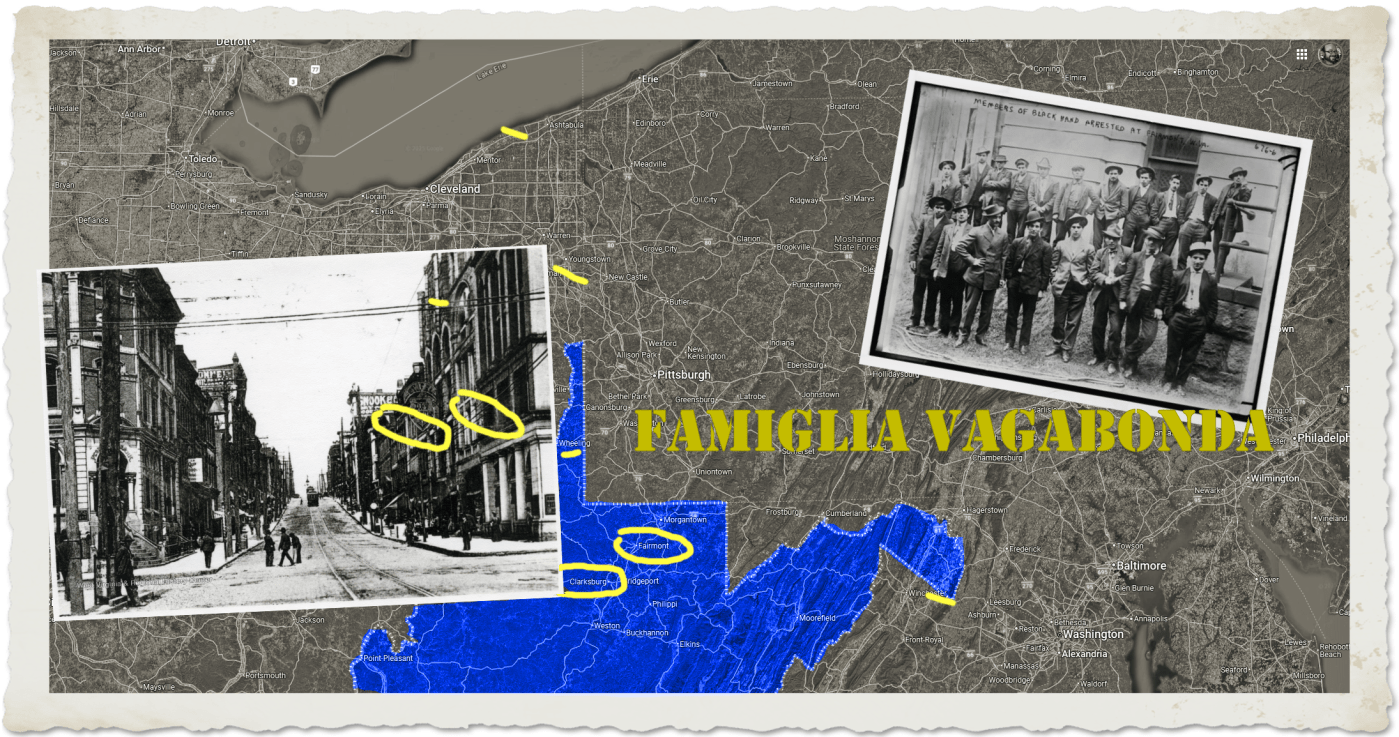
In the early 20th Century, Italians found work in the coal mines of West Virginia and stayed to create a pocket of Italian America that few outsiders know.
In Fairmont, West Virginia in the Twenties, the Famiglia Vagabonda held the reins to every legal and illegal vice. In 1927, Italian entrepreneur Joseph Argiro debuted the pepperoni roll in Fairmont: a kind of pared down stromboli stuffed with another American invention, pepperoni. Like the pepperoni roll, the Famiglia’s offerings were designed to cater to the needs and tastes of Italian coal miners.
Wherever Italian immigrants settled in large numbers, there were Italian criminals preying upon them. In West Virginia’s coal mining counties, predators contrived to coax the dollars from their countrymen’s pockets. They ranged from low pickpockets and confidence men to the owners of large establishments. At this end of the range, the opportunists provided booze and other recreational drugs, and places to consume them; hosted games of chance; and imported sex workers to mingle with the hundreds of lonely men. To keep it all running smoothly there were enforcers, guards, pimps, and for the really hard cases, arsonists, strong arm professionals, and hit men. Organized crime.
Histories of organized crime in the region often begin with Big Bill Lias. Lias was of Greek heritage, and controlled vice in Wheeling, West Virginia, about 70 miles northwest of Fairmont. In a couple of his rackets, Lias was beholden to Mafia bosses from other cities. He reportedly paid Johnny Torrio in Chicago for the wire service that allowed him to take sports bets, and Stefano Maggadino in Buffalo for some other service related to the vice trades.[1] So although not qualified to be a member of an ethnic mafia, he was one of its major customers.
Separate from Lias and his operation were the Famiglia Vagabonda, or Wandering Family, an organized criminal gang with an all-Italian membership. The Famiglia had at least two crews, one in Fairmont, WV, the seat of Marion County, and another in the Harrison County seat of Clarksburg, WV, about twenty miles to the southwest.[2]
Migrants to the coal fields of West Virginia generally arrived via the port of New York, and might move around frequently in search of work. There were thousands of coal miners in the region living far from their families. All of these rootless, friendless men were dollar signs to career criminals like Lias and the Famiglia leadership. Lias in Wheeling and the Famiglia in Clarksburg and Fairmont hosted brothels, saloons, and gambling. The Famiglia also ran classic mafia rackets like kidnapping for ransom and blackmail.
The Famiglia Vagabonda was reportedly founded by Frank Piscioneri in Marion County, West Virginia in 1908.[3] Piscioneri was found guilty in 1909, along with eight other men, of felonious conspiracy to assault and rob. Ten more men in the same case were convicted of misdemeanor crimes.[4]
The next leader of the Famiglia who appeared in the news was John Torcha. Torcha was born Giovanni Torchia in San Giovanni in Fiore, in Calabria, in 1880. He arrived in the US around 1902 and claimed he was made to pay a membership fee to the Famiglia Vagabonda in Fairmont. But he was not their victim: he was their co-commander. A double murder committed on Christmas Eve of 1914 was painted by attorneys for the defense as having been orchestrated by Torcha and Charley Rando, the leaders of the Famiglia Vagabonda.[5] Facing these charges, Torcha turned state’s witness. His followers, five young men ranging from 18-25, were sentenced to up to ten years in prison. The wife of one of the youths went to prison for a year for taking part in the conspiracy.
Originally Torcha expected to be sent home to Italy with his wife and children when he was done testifying against his fellows, but he changed his mind and the family remained in Marion County.[6] John became a US citizen in April 1922. The prosecuting attorney in the murder trial, Tusca Morris, swore an affidavit for his naturalization petition.[7]
In Clarksburg, the local Famiglia crew was led by “Big Joe” Cenetti. (His name is spelled Cignetti or Cignetto in most records, but not on his death certificate.[8]) Born in Strambino, a comune of Torino, Big Joe was a northern Italian: a Piemontese.[9] He arrived in 1903 and worked in coal mines. According to legend, Cignetti was a physically powerful man who could straighten a horseshoe with his bare hands.
“Big Joe” Cignetti was a bootlegger who was killed by unknown rivals in December 1921. Immediately after, five of his friends—Richard “Dapper Dick” Ferri, Philip Connizzaro, Nicholas Salamante, Samuel Muratore, and Pasquale “Patsy” Corbi—began looking for Frank Vesperer and Francesco Napolitano, aka Frank Naples, the two main rivals for Cignetti’s position in the underworld of Clarksburg. Vesperer was shot and seriously injured in February. Naples was lured out of hiding to his death soon after.[10] Vesperer escaped the hospital where he was recovering and ran to Baltimore, where he succumbed to the stress of his flight, and expired.[11]
The Famiglia Vagabonda was considered to be the ultimate power behind the retaliatory shootings. Cignetti’s five friends were charged with murder. Vito Corbi, who was Patsy’s father, and Vincenzo “Jim” Urso, the leader of the Famiglia in Fairmont, were charged as well. Jim Urso fled justice and wasn’t seen for almost twenty years. Ferri, Connizzaro, Salamante, and Muratore were all hanged. Patsy Corbi got a life sentence, later commuted, and was released in 1932.[12]
In 1923, nine of the Famiglia’s members were arrested in connection with a dozen murders and several dynamite bombings in West Virginia, Pennsylvania, and Maryland.[13] One of their victims was a woman.
Bella Lemon was found dead in the road outside a golf course near Baltimore, with nothing but a hat. The hat’s lining, made from a Fairmont, WV newspaper, enabled her identification. She had taken the train from Fairmont the same day. Police believed she was killed to keep her from exposing the blackmail gang of which she was a member.[14] Her friend, Carmela Malone, got a ride from Frank Corbi after getting out of jail in Baltimore, and disappeared.[15] Patsy and Tony Corbi were identified by three members of the Mafia in Clarksburg as Lemon’s killers, according to a Baltimore paper. Tony went on the run for years, with clues pointing to him hiding out in Mexico, Italy, and somewhere in the western United States. In 1926 it was reported that his arrest was imminent, but nothing came of it.[16]
The father of Patsy, Tony, and Frank was Vito Corbi, an immigrant from Catanzaro, Calabria. He started his family in Boston, Massachusetts, became a naturalized citizen, and moved to Baltimore, Maryland between 1910-1914.[17] In both cities he owned retail groceries. In the 1920s he branched out with his wife, Frances, into confectionery. (I’ve written here before about the relationship between candy production and bootlegging during Prohibition. While sugar was a more popular drug among teetotalers, leading to a rise in legitimate sales of candy in the Twenties, sudden veers into the business among gangsters were more likely to be fronts. “Sugar men” could order the raw ingredients of alcohol production without suspicion, and resell them on the black market.)

In 1939 the fugitive Tony Corbi got married in Youngstown, Ohio, to Katherine Mitolo, the widow of Nick Mallamo. Nick died in a bootleg war in 1927. The Mallamo brothers were born in Ardore, Reggio Calabria, and ran lotteries and other rackets in Youngstown.[18] Nick’s brother, Dominick Mallamo (1904-1987), future boss of the Youngstown Mafia, spent some of the 1930s living in Italy with his wife. Their only child, Giuseppe, was born there.[19]
The Youngstown Family had working ties to Calabrian gangs in Cleveland and Pittsburgh.[20] In the late Fifties, Tony Corbi and Dominick Mallamo jointly owned the Yo Hio social club.[21] In 1960, following founder Paul Romeo, Mallamo became the boss of the “Calabrese Organization” in Youngstown.

The fugitive Vincenzo Urso reappeared around the same time as Corbi, living with his family in Clairton City, a steel town outside of Pittsburgh.[22] Urso was remarkable among his colleagues in that he was a Sicilian deeply embedded in a Calabrian Mafia network.[23] In 1939, his daughter married Nunziato Quattrone, a Calabrian. Quattrone’s sister Laura was married to Antonio Ripepi, whose family had other connections to organized crime.
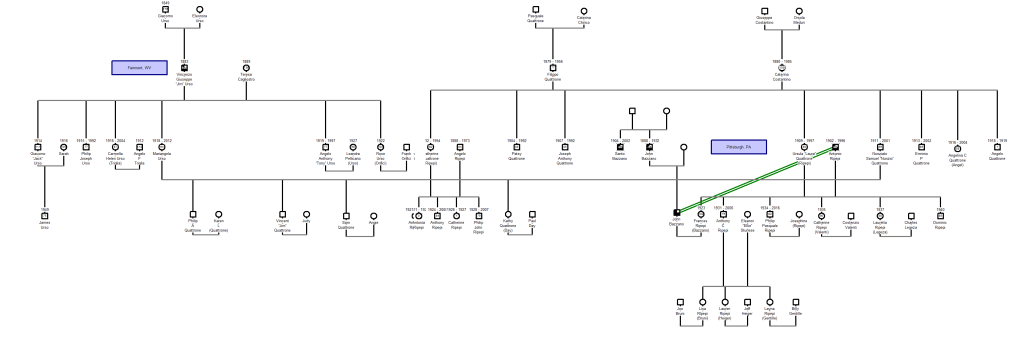
The Ripepi brothers were from Cervasi, in Reggio Calabria. Antonio’s older brother, Angelo, also married a Quattrone sister, making a double in-law marriage. Antonio Ripepi was active in the Pittsburgh Mafia through the 1980s. In one anecdote told about him, he shot Frank Corbi in the leg over a gambling debt.[24]
Ripepi’s daughter Frances married John Bazzano, Jr. John Sr. was a bootleg sugar supplier and became the boss of the Pittsburgh Mafia in 1931 after the assassination of Giuseppe Siragusa. Bazzano Sr. fought the Volpe family, whose base southeast of Pittsburgh was the small town of Wilmerding, and was implicated in at least three of their deaths. The Volpes were believed to be behind John Bazzano Sr.’s murder in 1932.[25]
In the 1930s and 40s, Patsy and Frank Corbi of Baltimore worked with Calabrian gangsters in Pittsburgh and Cleveland. By 1950, they were part of Lou Morici’s crew, made members of the Gambino crime family.
The Baltimore crew of the Gambino Family is a whole other story. To read more of this chapter in Mafia history, and support original Mafia scholarship, become a paid subscriber to Mafia Genealogy on Patreon at the Researcher level ($10/month).
Sources
- Big Bill – Wheeling’s Gangster Era – A Spoken Word Project – Wheeling WV History. (2022, December 15). Wheeling History [YouTube Channel]. https://www.youtube.com/watch?v=LZPfmwL4W1o
- Foster, G. (2023, January 3). Back in the day, this quiet West Virginia town was a mafia mecca. Only In West Virginia [Website]. https://www.onlyinyourstate.com/trip-ideas/west-virginia/mafia-town-wv
- Ibid.
- Biennial report and official opinions of the Attorney General of the State of West Virginia. Office of the Attorney General. P. 328. Google Books
- Samuel Palma on the Stand. (1915, March 20). The West Virginian. [volume] (Fairmont, W. Va.), Pp. 1, 8. Chronicling America: Historic American Newspapers. Lib. of Congress. <https://chroniclingamerica.loc.gov/lccn/sn86072054/1915-03-20/ed-1/seq-1/>; Five plead guilty of second degree murder. (1915, March 22). The West Virginian. [volume] (Fairmont, W. Va.). P. 1. Chronicling America: Historic American Newspapers. Lib. of Congress. <https://chroniclingamerica.loc.gov/lccn/sn86072054/1915-03-22/ed-1/seq-1/>
- Torcha’s story is again told before a jury. (1915, March 31). The West Virginian. [volume] (Fairmont, W. Va.), P. 1. Chronicling America: Historic American Newspapers. Lib. of Congress. <https://chroniclingamerica.loc.gov/lccn/sn86072054/1915-03-31/ed-1/seq-1/>, <https://chroniclingamerica.loc.gov/lccn/sn86072054/1915-03-20/ed-1/seq-8/>
- Arrest 2 more of alleged ‘mafia.’ (1915, February 19). The West Virginian. [volume] (Fairmont, W. Va.), p. 10. Chronicling America: Historic American Newspapers. Lib. of Congress. <https://chroniclingamerica.loc.gov/lccn/sn86072054/1915-02-19/ed-1/seq-10/>; “West Virginia, Naturalization Records, 1814-1991,” database with images, FamilySearch (https://familysearch.org/ark:/61903/3:1:9392-HX9S-K2?cc=1909003&wc=M6LB-MZ9%3A179597001%2C179649501 : 1 July 2016), Marion > Naturalization Records, 1920-1921, v. 5 > image 255 of 256; West Virginia State Archives, Charleston.
- Joseph Cignetti household. (1920). “United States, Census, 1920,” database with images, FamilySearch (https://familysearch.org/ark:/61903/3:1:33SQ-GRJR-CSX?cc=1488411&wc=QZJB-SHD%3A1036473501%2C1039390001%2C1036476301%2C1589333117 : 13 September 2019), Pennsylvania > Westmoreland > Washington > ED 234 > image 13 of 28; citing NARA microfilm publication T625 (Washington, D.C.: National Archives and Records Administration, n.d.).; Death of Joseph Cenete. (1921, December 28). Cert. no. 8578. West Virginia State Department of Health.
- Atto di nascita, Giuseppe Cignette di Lorenzo. (1874, March 12). Record no. 25. “Italia, Torino, Ivrea, Stato Civile, 1865-1937 (Tribunale),” images, FamilySearch (https://familysearch.org/ark:/61903/3:1:33S7-L1G3-D19?cc=1475996&wc=SG14-N38%3A1292372903%2C1292374602%2C1292392302 : 11 August 2014), Torino > Strambino > Nati 1872-1875 > image 94 of 192; Tribunale di Ivrea, Ivrea (Ivrea Court, Ivrea).; “United States, World War I Draft Registration Cards, 1917-1918,” database with images, FamilySearch (https://familysearch.org/ark:/61903/3:1:33SQ-G1VJ-FNS?cc=1968530&wc=9F8F-RM9%3A928312701%2C929078801 : 26 August 2019), Pennsylvania > Westmoreland County no 4; A-E > image 1162 of 1904; citing NARA microfilm publication M1509 (Washington, D.C.: National Archives and Records Administration, n.d.).
- “West Virginia, Deaths, 1804-1999”, , FamilySearch (https://www.familysearch.org/ark:/61903/1:1:F1L9-ZYS : Sat Aug 31 03:59:41 UTC 2024), Entry for Frank Napolatono, 16 Feb 1922.
- Gollomb, J. (1942, July 12). The case of the faceless girl. The American Weekly. Pp. 10-11.
https://tile.loc.gov/storage-services/service/ndnp/mimtptc/batch_mimtptc_fraser_ver01/data/sn88063294/00414187675/1942071201/0897.pdf - Foster, 2023. (See footnote 2.)
- February 11, 1923: Eight Members of the Black Hand Arrested in Harrison County. (2020, February 11). WVPB Education [Website]. https://wvpublic.org/february-11-1923-eight-members-of-the-black-hand-arrested-in-harrison-county/
- Arrest of slayer likely is claim. (1926, February 22). The Daily Times (Salisbury, MD). P. 1. https://www.newspapers.com/article/the-daily-times-arrest-of-slayer-likely/52160333/
- Malone woman believed likely to appear today. (1923, February 14). The Evening Sun (Baltimore, MD). P. 26. https://www.newspapers.com/article/the-evening-sun/159825461/
- Arrest of slayer likely is claim. (1926, February 22). The Daily Times (Salisbury, MD). P. 1. https://www.newspapers.com/article/the-daily-times-arrest-of-slayer-likely/52160333/
- “United States, Census, 1900,” database with images, FamilySearch (https://familysearch.org/ark:/61903/3:1:S3HT-DTJW-61N?cc=1325221&wc=9BQG-W3J%3A1030549901%2C1034570401%2C1034824301 : 5 August 2014), Massachusetts > Suffolk > ED 1225 Precinct 3 Boston city Ward 6 > image 11 of 22; citing NARA microfilm publication T623 (Washington, D.C.: National Archives and Records Administration, n.d.).; “United States, Census, 1910,” database with images, FamilySearch (https://familysearch.org/ark:/61903/3:1:33SQ-GRK3-HLB?cc=1727033&wc=QZZ4-5XG%3A133638101%2C141688201%2C141796001%2C1589219009 : 24 June 2017), Massachusetts > Suffolk > Boston Ward 6 > ED 1329 > image 13 of 40; citing NARA microfilm publication T624 (Washington, D.C.: National Archives and Records Administration, n.d.).
- Atto di nascita, Domenico Santo Mallamo. (1904, August 22). Record no. 103. Archivio di Stato di Reggio Calabria > Stato civile italiano > Ardore > 1904 > Nati https://antenati.cultura.gov.it/ark:/12657/an_ua16369388/Lo4ok8j Img 36 of 86; Atto di nascita, Nicola Antonio Mallamo. (1900, April 26). Record no. 72. Archivio di Stato di Reggio Calabria > Stato civile italiano > Ardore > 1900 > Nati https://antenati.cultura.gov.it/ark:/12657/an_ua16369384/wXq7my3 Img 26 of 76
- Dominic Mallomo household. (1940, April 10). “United States Census, 1940,” database with images, FamilySearch (https://familysearch.org/ark:/61903/3:1:3QSQ-G9M1-93XT?cc=2000219&wc=QZXY-82F%3A790106001%2C794512701%2C795035401%2C795130101 : accessed 18 October 2021), Ohio > Mahoning > Youngstown City, Youngstown City, Ward 7 > 96-144 Youngstown City Ward 7 (Area C – part) > image 15 of 32; citing Sixteenth Census of the United States, 1940, NARA digital publication T627. Records of the Bureau of the Census, 1790 – 2007, RG 29. Washington, D.C.: National Archives and Records Administration, 2012.
- FBI Rec no. 124-10287-10209, Rec. Series HQ, Agency File no. 92-6954-651, from J. Edward Burke to the Director of the FBI. Orig. 69 pp. Unclassified. 15 June 1964. Retrieved from https://www.archives.gov/files/research/jfk/releases/docid-32305079.pdf on 7 October 2021.
- Critchley, D. (2009). The origin of organized crime in America: The New York City Mafia, 1891-1931. Routledge, p. 248, Note 90.
- James Urso household. (1940). “United States, Census, 1940,” database with images, FamilySearch (https://familysearch.org/ark:/61903/3:1:3QS7-L9MT-VQPH?cc=2000219&wc=QZX5-QBJ%3A790227701%2C790433501%2C790862101%2C951016901 : accessed 17 January 2025), Pennsylvania > Allegheny > Clairton City, Clairton, Ward 2 > 2-89 Clairton City Ward 2 (Tract 45 – part) bounded by (N) Shaw Av, State, Maple Av; (E) Monongahela River; (S) city limits;
 State, St. Clair Av, Reed > image 6 of 28; citing Sixteenth Census of the United States, 1940, NARA digital publication T627. Records of the Bureau of the Census, 1790 – 2007, RG 29. Washington, D.C.: National Archives and Records Administration, 2012.
 - “West Virginia, Naturalization Records, 1814-1991,” database with images, FamilySearch (https://familysearch.org/ark:/61903/3:1:9392-4P6B-6?cc=1909003&wc=M6LY-B3D%3A179597001%2C179646001 : 1 July 2016), Marion > Naturalization Records, 1914-1917, v. 3 > image 158 of 255; West Virginia State Archives, Charleston.
- HairyKnuckles. (2012, July 17). Frank Corbi, his brothers and his crew. Gangster BB [Bulletin board]. http://www.gangsterbb.net/threads/ubbthreads.php?ubb=showflat&Number=656239
- Hunt, T. (2021). John Bazzano (1889-1932). The American Mafia [Website].
https://mob-who.blogspot.com/2011/04/bazzano-john-1889-1932.html
 Mafia Genealogy
Hi, do you know where Francesco Napolitano was born? Thanks.
LikeLike
No, I wasn’t able to find that out.
LikeLiked by 1 person
Thank you
LikeLike
Big Joe Ceniti was from Spadola, Catanzaro, Calabria (his grandson gave me this info). He fled Chicago to WVa after being indicted for extortion, and became head of the Clarksburg crew but, when he vetoed the suggestion to extort a prosperous local business owner, Frank Naples, Joe Costa and Frank Vesperer decided to do it anyway. When the business owner rebuffed their demands they shot and seriously wounded his wife. As retaliation for disobeying his order, Ceniti kicked Naples and Vesperer out of the crew but apparently didn’t realize Costa had been part of it. On 28 Dec 1921 Costa lured Ceniti to a remote location under the guise of picking up a liquor shipment – Naples and Vesperer shot him to death in his car and left him there. In response to this major violation of the code of the Honored Society (now ‘ndrangheta) the Fairmont crew then held a council, led by Joe Sergi and Jim Urso, and decided that Naples, Vesperer and Costa had to be killed. This decision was supported by Vito Corbi out of Baltimore. Dapper Dick Ferri was put in charge with support from Big Nose Philip Conizzaro (who had links to both the Clarksburg and Fairmont branches), Nick Salamante and Julius Bozzi. They planned to kill Naples, Vesperer and Costa at Ceniti’s funeral, but the three men didn’t show up – so the next plan were the two drive bys in which Vesperer was wounded and Naples was killed. Costa apparently got out of town and got away.
Bella Lemons wasn’t a member of the crew – she was pimped by them, but they all had a hard time controlling her. Big Rosie DeMarco was her first known pimp with the crew (he was from Chicago and came to WVa with Ceniti) and he used to get into fistfights with her on the streets in Fairmont. (Previously she had been pimped by Charles Milan who was a peripheral ganster but not apparently part of any specific crew). After Big Rosie broke the rules by holding back some of his earnings and was disciplined, he ended up running back to Chicago where he was shot to death on the street in December 1922. Bella was reassigned to Big Nose Phil who also couldn’t control her. She was finally ‘given’ to Tony Corbi to run. When he couldn’t control her either, the decision to kill her was made by Vito Corbi and he assigned Tony to do the job, with the idea that that would then give Tony full status in the group (Tony apparently hadn’t killed anyone until then). Big Nose Phil drove the car they were all in. Bella fought back and Tony massively botched the job, leading to Bella’s swift identification and the knowledge that he and Patsy were the murderers). In his testimony at the 1923 trials of Patsy Corbi, Dapper Dick, Big Nose Phil and Nick Salamante, former Fairmont branch secretary, Rocco Fiorrello said that the reason Bella was killed was because ‘she told secrets’ and ‘laughed at our theats’. (Rocco was found hacked to death a year later.)
I’m intrigued by your research into the Ursos. There were two sets of Urso brothers (Jim/Vicenzo and Salvatore/Sam) living in Marion County at the same time. One set were from Calabria while the others were the Sicilians you researched. I’d assumed that the Calabrian Ursos were the ones involved in the Fairmont Branch – the Calabrian Jim also disappears from the records right around the same time as the murders – but as far as I’ve been able to tell, never resurfaces. I found some info online that he’d gone to Canada, but didn’t find any hard evidence of that. His brother, the Calabrian Sam Urso lived in Marion Count, WV the rest of his life. But now I’m going to have to go back and look at all that again and the Sicilian Urso brothers – I noticed that Joe Sergi signed the Sicilian Jim Urso’s naturalization papers – and those Pittsburgh marriage alliances are really interesting.
LikeLike
This is a thrilling account, and thank you. I don’t think I picked up on the Calabrian Ursos at all, though IIRC it was a pretty common surname in the area.
How sure is his grandson that Ceniti was from Spadola? I was able to trace him to Crotte, Strambino, Turin, Piedmont, Italy, where he was born and married. His wife’s name on his WWI draft registration is a decent match for the marriage record (it mangles her surname but that happens), and the names of his first two children match his own parents.
LikeLike
Frank Naples was most likely originally from Caulonia, Reggio de Calabria -although I haven’t found documents for him that say this, his brother Ilario/Larry’s immigration and naturalization records have this information.
LikeLike
I’ve looked for his birth in Caulonia and haven’t found it there, nor in San Giovanni in Fiore, nor in Licata.
LikeLike
I’m having a hard time leaving comments in order, so sorry that this not going under your comment. They are pretty certain that Cenite was from Calabria. I have his WWI registration but in Chicago – and as far as they know, he only had the one daughter. That’s not to say he didn’t have more though with someone else – they told me that all they knew was he fled Chicago with Rosie DeMarco and was killed in West Virginia – interestingly Rosie DeMarco was the informant on Cenite’s death certificate and said he was single… which… Are you able to view this? it’s all the info I have for him and the DC is there too. Inspired by your post, I did a little more research into the Sicilian Ursos and am convinced that you’re right, and I was off. The Sicilian Jim Urso was married to a Calabrese woman from Cerasi, Reggio – and her family was extensively tied into the other Calabrese mafia linked families (her brother was married to a Ripepi) then his kids, like you noted, married in as well. Seeing Joe Sergi’s name on his naturalization papers – I don’t know why I didn’t think more about that before. So glad I found your blog!
LikeLike
Thank you for connecting some dots for me. I have seen Ceniti’s death certificate and had a note to myself, asking who Rosie DeMarco was, but I never followed up on her. Here is where you can see the birth record I found for Ceniti. You can see the date of birth is a match for his death record. https://familysearch.org/ark:/61903/3:1:33S7-L1G3-D19?cc=1475996&wc=SG14-N38%3A1292372903%2C1292374602%2C1292392302 If you look on Find a Grave you’ll see that at least some of his children used the “Cignetti” spelling and are buried in the same Riverview Cemetery in Apollo, Armstrong, PA. If you’ve seen his WWI draft registration, note his wife’s surname and then look at this marriage record: https://familysearch.org/ark:/61903/3:1:33S7-81G3-2Y3?cc=1475996&wc=SG14-L26%3A1292372903%2C1292374602%2C1292375426 I think you’ll agree this is the same person.
LikeLike
Hi again – Rosario ‘Big Rosie’ Demarco came to West Virginia from Chicago with Joe Cenite. Cenite and Demarco ran a restaurant together in Fairmont at one point. I think some of the confusion lies in the fact that Big Joe Cenite and Joe Cignetti both died in 1921, but they are different people. Cenite was shot to death outside Clarksburg in December 1921, while Cignetti’s tombstone says he died in Pennsylvania on September 1921. According to his DC, Cignetti died of paralysis brought on by influenza. There is no birth date on Cenite’s death certificate but on his WWI draft registration (in Chicago), it is given as 7 June 1881. His wife, Amelia’s maiden name is Silvestri. They only had one child, a daughter – Angela Theresa Cenite, b 1917 – and she lived her whole life in the Chicago area. According to his grandson, the surname was originally Ceniti, he said that Joe had a brother, Luigi Ceniti/e who was stabbed to death in Chicago, but I haven’t looked into him yet.
LikeLike
“…Big Joe Cenite and Joe Cignetti both died in 1921, but they are different people.”
You’re right. That’s a good catch. I’ll have to work on this one some more.
LikeLike
I pieced most, but not all, of this together myself over the last three years. I was aware of Jim Urso’s connection to Antonio Ripeppi through the Quattrones. I was not aware that Urso had another connection through his wife. It fits because Ripeppi hired relatives from Fairmont to work in his legal businesses. It also supports a theory I’ve had for a while that the Famiglia Vagabonda did not go away, but became the Ripeppi faction of the Pittsburgh family.
The ties back to Fairmont and Clarksburg still existed through the late 1970’s. FBI records state Mannarino & Ripeppi met with Paul Hankish a couple days after the murder of Clarksburg mob boss in 1976. Ripeppi was a very old man at that point and supposedly had been retired for decades.
LikeLiked by 1 person
Hello Justin. This is Joe Ceniti s grandson, Ed. I’m happy to collaborate with you, if you’re interested in any additional information.
LikeLike
Hi Ed, thank you for the offer! Email me at likethewatch@gmail.com.
LikeLike