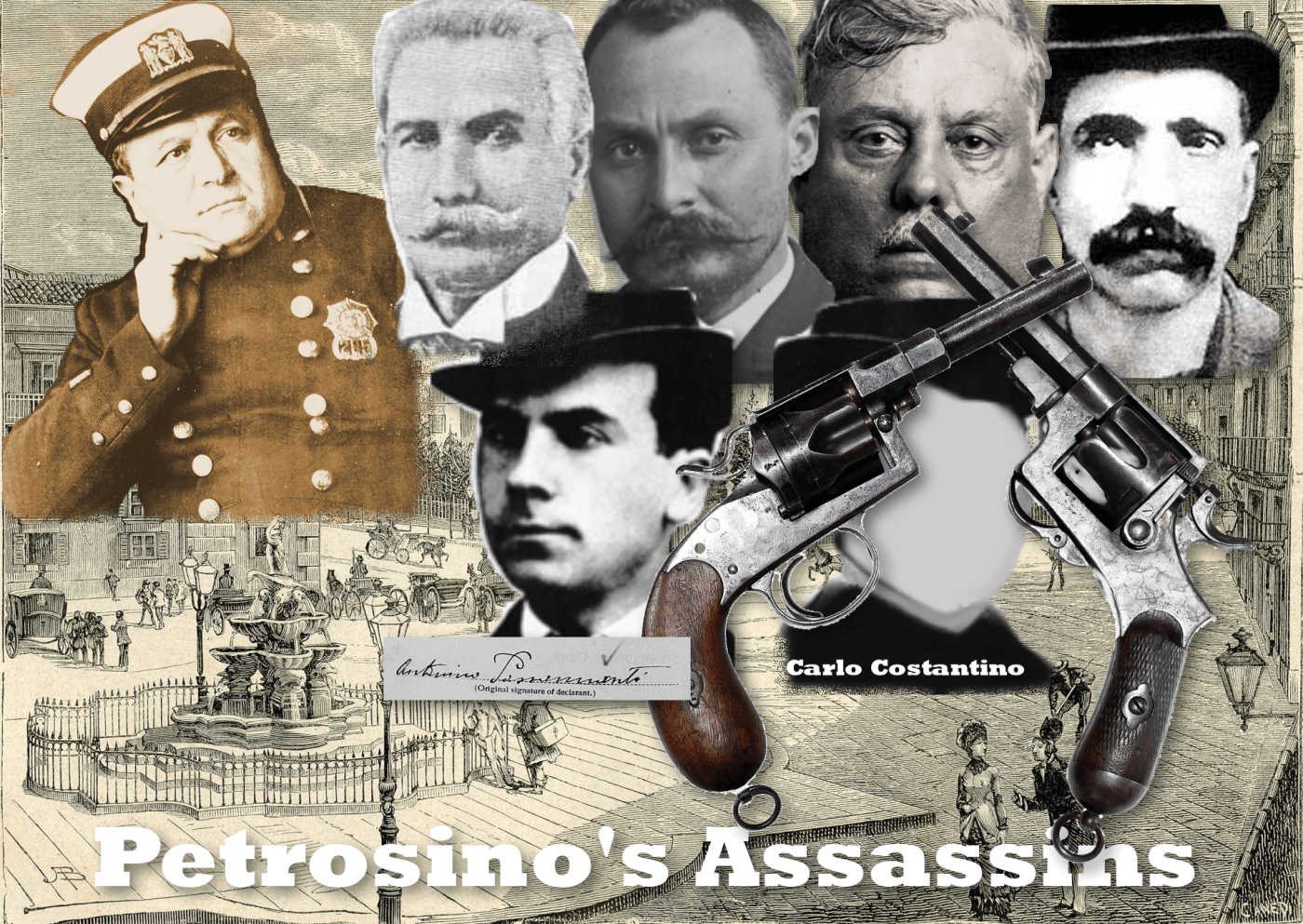
As the first decade of the 20th Century drew to a close, there were three Mafia Families in New York City. The first was formed by Giuseppe Morello, a Corleonese mafioso who from 1900-1909 was the Mafia’s capo dei capi in the United States. With his half brothers, he led the Morello Terranova Family of East Harlem during those years. Morello’s brother-in-law and frequent co-conspirator, Ignazio Lupo, was the boss of the second Mafia gang, based in the Lower East Side. Their two Mafia cosche were devastated by the incarceration of Morello and Lupo with their counterfeiting colleagues in 1910.
In March 1909, at the height of their power, Morello and Lupo were suspected of masterminding the assassination of New York City Police detective Joseph Petrosino. Evidence suggested they, along with the powerful Sicilian mafiosi Giuseppe Fontana and Vito Cascio Ferro, arranged for two assassins from Partinico to deliver a lethal message from the criminal fraternity’s highest ranking members on two continents.
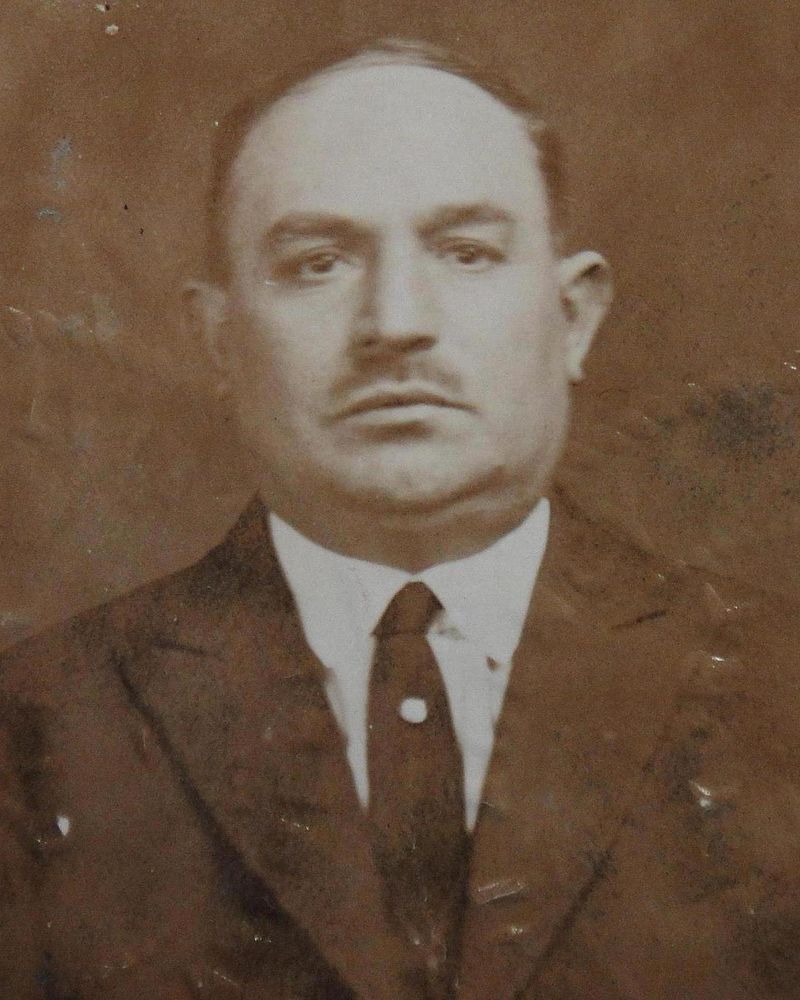
Nicola Schiro
The third Mafia gang in New York City were the castellammaresi in Williamsburg, Brooklyn, who would eventually be known as the Bonanno Family (Critchley, 2009, pp. 36, 131).[1] Nicola Schiro, one of the early leaders of the Brooklyn cosca, arrived in 1902 from Camporeale and was already attracting police attention in Brooklyn by 1905. His future brother-in-law and underboss, Salvatore Grippi, of Partinico, with whom he would have a lifelong relationship as criminal confidantes, immigrated in 1904. When Sebastiano DiGaetano stepped down as the leader of the Williamsburg cosca in 1912, Schiro replaced him. The following year, Grippi married Schiro’s sister, Domenica; the newlyweds were both in their thirties.[2]
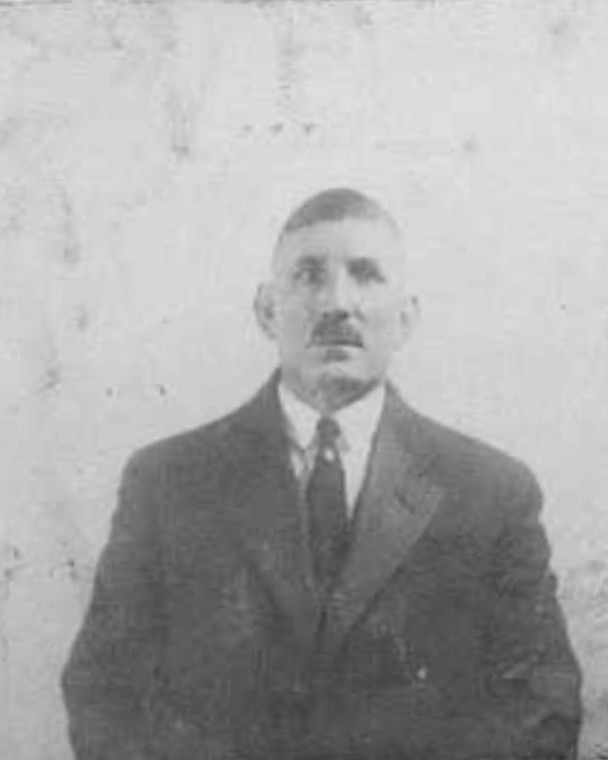
Salvatore Grippi
Both of the gunmen in the conspiracy to kill Petrosino, Carlo Costantino and Antonino Passananti, were from Partinico, like Grippi. The men were all in their thirties: Nicola Schiro was the oldest, born in 1872 (making him 37 years old in 1909), followed by Costantino in 1874, Grippi in 1877, and Passananti in 1878. Costantino was Grippi’s maternal first cousin. So was Costantino’s wife, Grazia Casarrubia. All three of their mothers were sisters: daughters of Salvatore Cusumano and Rosalia Sansone.
Connecting the gunmen through marriage, Antonino Passananti and Costantino’s wife were second cousins, once removed: Antonino’s mother was a Casarrubia.
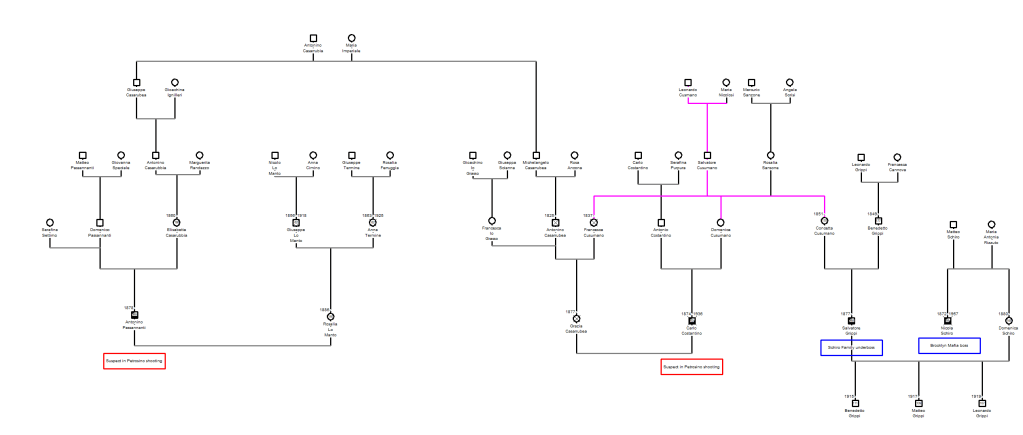
How Petrosino’s alleged assassins were related through blood and marriage to one another and to Brooklyn mafioso Nicola Schiro.
Costantino and Passananti were connected to Ignazio Lupo—and redoubled their ties to one another—through their business relations. The two men from Partinico were officers in a construction company that collaborated with Morello’s Ignazio Florio building cooperative. They were also active participants in Lupo’s grocery credit conspiracy in New York, a connection that drew them closer to Grippi. Costantino made his first trip to the United States in 1903, meeting a relative in Little Italy.[3] In 1905 Carlo Costantino immigrated again, joining his cousin Salvatore Grippi—not in Brooklyn, but at 307 E. 71st St in Manhattan, the address of a known hangout of the Black Hand, and where, in the next few years, Carlo would run a store for Lupo.[4]
Antonino Passananti (also spelled Passanante, the original spelling is Passannanti) was a carpenter descended from a line of master artisans. On his first trip to the United States—the same year as Costantino first immigrated, in 1903—he disembarked in New York claiming to be on his way to meeting a relative in New Orleans. I’ve had no luck identifying his destination contact, and it looks as though Passananti may have never left New York City.[5] He filed first papers for naturalization in 1907 calling himself an importer. His home address was 593 Flushing Avenue in South Williamsburg, Brooklyn: the same location from which he ran a store in Lupo’s ring.[6]
Lupo’s scam was not so different from the way the Mafia siphons value from a business today. Through proxies, including Passananti and Cosantino, Ignazio Lupo owned a number of grocery stores throughout the city, many of which he procured by forcing the rightful owner to sell with Black Hand threats.[7] Once in possession, Lupo purchased on credit as much merchandise as he could resell for cash on the black market, leaving the shelves of his stores bare.
Lupo’s public appearance in the city was of a highly prosperous grocer. Even his delivery wagons projected this image. When his creditors came calling, however, Lupo and his friends were nowhere to be found, and his grocery stores were full of nothing but empty boxes.
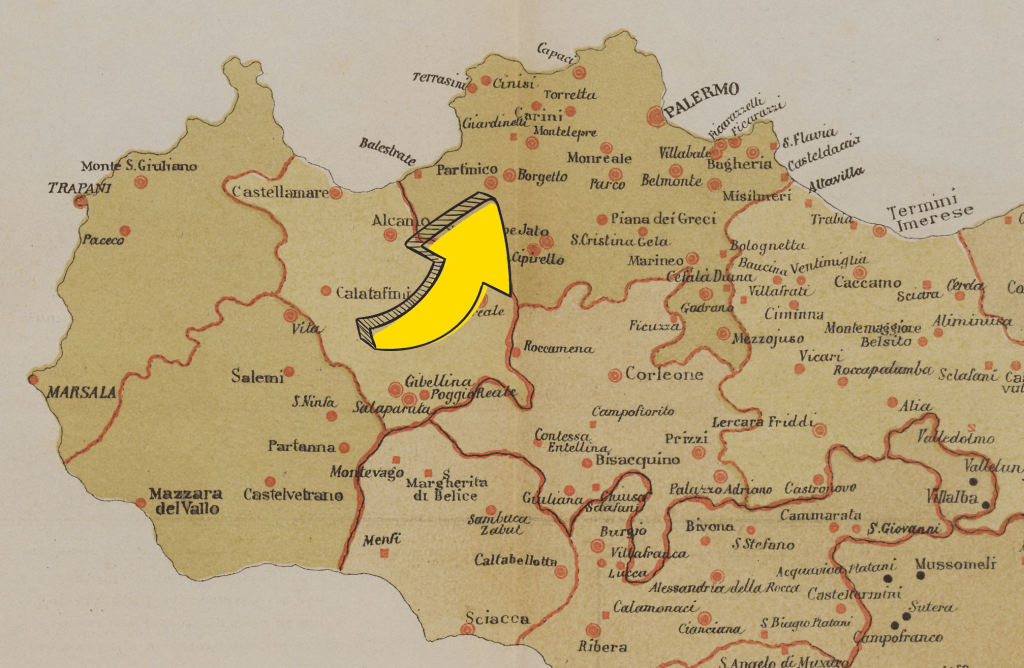
Partinico is in western Sicily, in the province of Palermo, near Borgetto.
Costantino and Passananti fled the US on the same voyage, arriving back in Sicily on 26 February 1909.[8] They were seen in Partinico by a policeman who recognized them. Word spread in their home comune, which is about twenty miles through the mountains from Palermo, that the two familiar criminals had returned from New York claiming to be dodging debtors, which had some truth in it. They were also flashing a lot of cash. Lupo followed suit about a week later, ducking as much as $100,000 in commercial debt: more than $3.6M today.[9]
The powerful Sicilian mafioso Vito Cascio Ferro had been in Partinico a few weeks earlier asking about the two men and apparently expecting their imminent arrival. Soon after arriving in Sicily and visiting their families in Partinico, Costantino and Passananti sought him out. They were seen talking to Cascio Ferro in Partinico and, for some reason, in Corleone.
Costantino was known in Little Italy as someone who had publicly, repeatedly declared his hatred for Petrosino.[10] Lupo was also public about his hatred of Petrosino.[11] Giuseppe Fontana, who was also accused of conspiring against Petrosino, had been suspected of killing the Palermitan banker and politician Emanuele Notarbartolo in 1893. He immigrated afterward, making his home in New York. Fontana was part of the famous 1904 offer from Morello to a visiting Cascio Ferro to sit down together over a plate of macaroni. In 1909 Fontana was living in New York and still allied with Morello.
Joseph Petrosino had gone to Italy to gather evidence of the criminal histories of three thousand Italian nationals he believed should be deported from the United States. They were known criminals in their new home, and with their records in hand, Petrosino hoped to provide enough evidence to send them back to Italy for good. His voyage was intended to be kept secret—he sailed under an alias—but the news was leaked to the Italian press from within the NYPD.[12] At first, Petrosino did not know his cover had been blown. He refused an Italian police escort as he traveled throughout the country. However, a series of strange interactions soon convinced him, and he began to halfheartedly cover his tracks as he left Naples for Sicily.
Petrosino arrived in Palermo on 28 February: two days after his assassins. A couple weeks later on 12 March, he was eating his dinner in a cafe near his hotel when the two men approached him. Petrosino knew both men and probably trusted them as informants.[13] He willingly followed them outside to a nearby piazza. Four shots rang out in the darkness. Petrosino was dead.[14]
The police commissioner, Baldassare Ceola, whose protection Petrosino had refused, began rounding up suspects. Costantino was arrested in Palermo soon after the shooting.[15]
Strangely, it was Costantino and not Passananti with whom Morello had corresponded, leading up to the assassination. Of the two gunmen, Passananti, who came from a middle class family of artisans, could read and write. Costantino, a borgese—a wealthy citizen who could vote—was illiterate. This was not an absolute barrier. He could dictate a message to be sent, and have messages read to him. The proof that Costantino had been exchanging telegrams with Morello was found when he was arrested. They were still in his pockets, along with six thousand dollars.
Messages between Morello and Costantino were mainly delivered in a sort of code, with talk of wine and whiskers. None of the police detectives could determine their meaning. Costantino pretended to decode a message from Morello, but police did not believe him. One that Costantino sent to New York said, in Italian, “Am still trying to buy wine from Fortona.” Morello was later alleged to have confessed from prison that it meant Costantino had found Petrosino and would have his blood. Morello sent a telegram by cable to “C. Constantino” in Palermo shortly before Petrosino was killed. A telex found in Costantino’s home after his arrest, addressed to Fontana at Morello’s address, was more direct. It said “I Lo Baido lavoro Fontana,” which roughly translates as “I did the job Fontana asked me to do.”[16]
Anonymous letters pointed to a transatlantic coalition of mafiosi. After Petrosino’s murder, Sicilian authorities received a series of unsigned letters from New York claiming Morello, Lupo, Giuseppe Fontana, and others had banded together to send Costantino and Passananti to kill Petrosino, and that Cascio Ferro was responsible for orchestrating the assassination in Palermo.[17]
Morello, in prison in Atlanta, was interrogated by the Italian consulate. However, the case was effectively closed when the Palermo Court of Appeals discharged Cascio Ferro, Costantino, and Passananti in July 1911 due to insufficient evidence to send them to trial.[18]
Passananti, who disappeared the day of the shooting, turned himself in to police in 1916—seven years after the crime—as part of an agreement, and was released immediately. He returned to Partinico and married Rosalia Lo Manto that November. They had two sons, both born in Partinico.[19]
In the early 1920s, when fascism was on the rise in Italy, Passananti was linked to Santo Termini, the boss of San Giuseppe Jato, helping arrange fake passports. He returned to New York in May 1924, going to the Brooklyn home of Salvatore Grippi, who he called his cousin. In November he made the trip again, escorting his wife and children. With them, and named next on the travel manifest, was Gaspare Messina, the boss of the Mafia in Boston, who got his start with the Schiro Family in Brooklyn. Passananti was charged in Italy in 1926 with conspiracy to commit forgery and bribery of an official. He appears to have been tried in absentia. There’s no record of his making another trip to Italy, while there is, a few years later, evidence he moved his family to San Francisco, California, and then to Cleveland, Ohio, while working as a salesman for a retail grocer.
Carlo Costantino spent most of his remaining years imprisoned by the Italian government. He went away for fraud and served time first in Palermo’s Ucciardone prison, then in Lampedusa, before returning to Palermo, where he died in a mental hospital around 1936. His cause of death was most likely the final stage of syphilis, contracted in 1905: the year he first arrived in New York.[20]
Passananti’s sons married in Partinico in the early 1940s. Antonino Passananti lived the rest of his life in his home comune . He applied successfully for a drivers license while in his eighties. According to Arrigo Petacco, Passananti lost his license again when he was 89. He killed himself the following winter.[21]
[1] Critchley, D. (2009). The origin of organized crime in America: The New York City Mafia, 1891-1931. Routledge.
[2] Marriage of Salvatore Grippi and Domenica Schiro’. (1913, March 30). Cert. no. 2670. Brooklyn. DORIS. https://a860-historicalvitalrecords.nyc.gov/view/8899511
[3] Manifest of the SS La Lorraine. (1903, January 31). Statue of Liberty & Ellis Island Foundation [website]. https://www.statueofliberty.org/arrival-details/?id=JFP8-Q49
[4] Black, J. (n.d.) The Grocery Conspiracy. Gang Rule [website].
https://www.gangrule.com/events/the-grocery-conspiracy; Manifest of the Lombardia. (1905, June 1). Line 8. Statue of Liberty & Ellis Island Foundation [website]. https://www.statueofliberty.org/arrival-details/?id=JFHJ-Q2K
[5] Manifest of the SS North-America. (1903, January 30). Line 3. Statue of Liberty & Ellis Island Foundation [website]. https://www.statueofliberty.org/arrival-details/?id=JFPZ-J4Q
[6] “Brooklyn, Kings, New York, United States records,” images, FamilySearch (https://www.familysearch.org/ark:/61903/3:1:3QSQ-G9MD-9TZZ?view=explore : Aug 5, 2026), image 1309 of 1315; . Image Group Number: 005412276; Black, J. (n.d.) The Grocery Conspiracy. Gang Rule [website]. https://www.gangrule.com/events/the-grocery-conspiracy
[7] Dash, M. (2009). The first family: Terror, extortion, revenge, murder, and the birth of the American Mafia. Random House. Pp. 164-166.
[8] Petrosino’s slayer may be in custody. (1909, April 7). The New York Times. P. 4.
[9] Black, J. (n.d.). The grocery conspiracy. Gang Rule [website]. Accessed 23 May 2025. https://www.gangrule.com/events/the-grocery-conspiracy
[10] Petrosino’s slayer may be in custody. (1909, April 7). The New York Times. P. 4.
[11] Get suspect in Petrosino case. (1909, November 18). Press and Sun-Bulletin [Binghamton, NY]. P. 1.
[12] Dash, M. (2009). The first family: Terror, extortion, revenge, murder, and the birth of the American Mafia. Random House. Pp. 268-272.
[13] Landolfi, F. (2025, May). The cop and the mob: Joe Petrosino against the Mafia in the United States and Italy during the Progressive Era. Historical Research. Vo. 98, Issue 280. Pp. 266-284. https://academic.oup.com/histres/article/98/280/266/7979285
[14] Dash, M. (2009). The first family: Terror, extortion, revenge, murder, and the birth of the American Mafia. Random House. Pp. 270-280.
[15] Italian ‘wolf’ may be slayer of Petrosino. (1909, November 18). The Kansas City Post. P. 7.
[16] Lupo, S. (2015). The two mafias: A transatlantic history 1888-2008. New York: Palgrave MacMillan. (Originally published as Quando la mafia trovò l’America in 2008) P. 26.
[17] Dash, M. (2009). The first family: Terror, extortion, revenge, murder, and the birth of the American Mafia. Random House. P. 281; Lupo, S. (2015). The two mafias: A transatlantic history 1888-2008. New York: Palgrave MacMillan. (Originally published as Quando la mafia trovò l’America in 2008) Pp. 23, 24.
[18] Black Hand crimes doubled in year just ended. (1911, December 31). The New York Times. P. 39; Critchley, D. (2009). The origin of organized crime in America: The New York City Mafia, 1891-1931. Routledge. P. 69.
[19] Petacco, A. (1972). Joe Petrosino. Arnoldo Mondadori Editor. Print. P. 221.
[20] Petacco, A. (1972). Joe Petrosino. Arnoldo Mondadori Editor. Print. P. 223-4.
[21] Petacco, A. (1972). Joe Petrosino. Arnoldo Mondadori Editor. Print. P. 221.


Leave a Reply